
What tests need to go through in the s355mc steel equivalent astm production process
Explore the rigorous testing protocols for S355MC and its ASTM equivalents. This guide covers chemical analysis, mechanical testing, and NDT procedures essential for high-performance steel production.
The Critical Role of Quality Verification in S355MC and ASTM Equivalent Production
S355MC steel, a high-yield strength material governed by the EN 10149-2 standard, is a cornerstone of modern automotive and structural engineering. When identifying an ASTM equivalent, such as ASTM A1011 HSLAS Grade 50 or ASTM A656 Grade 50, the production process must adhere to stringent testing protocols to ensure that the thermomechanically rolled (TMCP) properties are maintained. These tests are not merely procedural formalities; they are the scientific backbone that guarantees structural integrity, weldability, and safety in high-stress environments. Understanding the specific tests required during the production of these equivalents is vital for engineers and procurement specialists who demand reliability in their supply chains.
Chemical Composition Analysis: The Elemental Blueprint
The first stage of testing begins in the laboratory with a comprehensive chemical analysis. For S355MC and its ASTM counterparts, the balance of alloying elements is delicate. Producers utilize Optical Emission Spectroscopy (OES) or Inductively Coupled Plasma (ICP) to verify the melt analysis. The primary focus is on limiting carbon content to enhance weldability while utilizing micro-alloying elements like Niobium (Nb), Vanadium (V), and Titanium (Ti) to achieve grain refinement.
Testing must confirm that the Carbon Equivalent Value (CEV) remains within specified limits. A lower CEV is essential for preventing cold cracking during welding, a common requirement for the heavy-duty chassis and crane booms where this steel is typically utilized. The following table illustrates the typical chemical requirements for S355MC compared to its common ASTM equivalent:
| Element (Max %) | S355MC (EN 10149-2) | ASTM A1011 HSLAS-F Gr 50 |
|---|---|---|
| Carbon (C) | 0.12 | 0.15 |
| Manganese (Mn) | 1.50 | 1.65 |
| Silicon (Si) | 0.50 | - |
| Phosphorus (P) | 0.025 | 0.020 |
| Sulfur (S) | 0.020 | 0.020 |
| Niobium (Nb) | 0.09 | 0.005 min |
Mechanical Property Testing: Defining Load-Bearing Limits
Mechanical testing is the most rigorous phase of the quality assurance process. For S355MC, the "355" denotes a minimum yield strength of 355 MPa. The ASTM equivalents must meet similar thresholds, typically verified through Tensile Testing according to ASTM E8 or EN ISO 6892-1. This test determines the yield point, ultimate tensile strength, and percentage of elongation. Because S355MC is designed for cold forming, the elongation properties are scrutinized to ensure the material can withstand complex shaping without fracturing.
Beyond standard tensile tests, Impact Toughness is evaluated using the Charpy V-notch test (ASTM E23). This is particularly critical for materials used in cold climates or dynamic loading scenarios. S355MC is often tested at -20°C or -40°C to ensure that the transition from ductile to brittle behavior occurs well below the operating temperature. A typical requirement might be a minimum of 40 Joules at the specified temperature, ensuring the steel can absorb energy during sudden impacts.
Cold Forming and Bend Testing: The MC Designation
The "MC" in S355MC stands for thermomechanically rolled (M) and cold forming (C). Therefore, the Bend Test is a non-negotiable part of the production cycle. Samples are bent over a mandrel of a specific radius (often related to the thickness of the plate) to an angle of 180 degrees. The outer surface of the bend is then inspected for cracks or fissures. This test confirms the material's ductility and its ability to be processed in automated folding and pressing lines without failure.
- Mandrel Diameter: Determined by the material thickness (t), usually 0.5t to 1.5t for S355MC.
- Visual Inspection: Absence of any surface tearing indicates a successful test.
- Springback Analysis: While not always a mandatory standard test, many manufacturers perform springback assessments to assist downstream fabricators.
Microstructural Examination and TMCP Validation
Thermomechanical Control Processing (TMCP) is what gives S355MC its unique strength-to-weight ratio. Unlike traditional normalized steels, the properties are achieved through controlled rolling and cooling rates. To verify this, Metallographic Examination is performed. Using high-powered microscopes, technicians analyze the grain size and the distribution of phases. A fine-grained ferrite-pearlite structure is the hallmark of a well-produced S355MC equivalent.
Testing for grain size (according to ASTM E112) ensures that the micro-alloying elements have effectively pinned the grain boundaries during the rolling process. This fine grain structure is responsible for both the high yield strength and the excellent low-temperature toughness. Any signs of grain coarsening or unwanted martensitic structures would indicate a failure in the TMCP cooling parameters, leading to a rejection of the batch.
Non-Destructive Testing (NDT) for Internal Integrity
For critical applications like mobile cranes or pressure vessel supports, internal defects that are invisible to the naked eye must be detected. Ultrasonic Testing (UT) is the primary NDT method used during the production of high-grade steel plates. UT scans the internal volume of the steel for laminations, inclusions, or voids that could compromise the structural integrity under load.
ASTM A578 is a common standard used for the ultrasonic examination of plain and clad steel plates for special applications. In addition to UT, Magnetic Particle Inspection (MPI) may be used on the edges of cut plates to ensure that no longitudinal cracks were introduced during the shearing or laser-cutting process. These NDT protocols provide a layer of security that destructive testing cannot, as they evaluate the actual product being shipped rather than a representative sample.
Surface Quality and Dimensional Precision
The aesthetic and functional utility of S355MC depends heavily on its surface condition. Production standards require a thorough Surface Inspection to detect pits, scales, or rolled-in impurities. Since this steel is often used in automotive frames that require painting or coating, a clean, smooth surface is essential for adhesion.
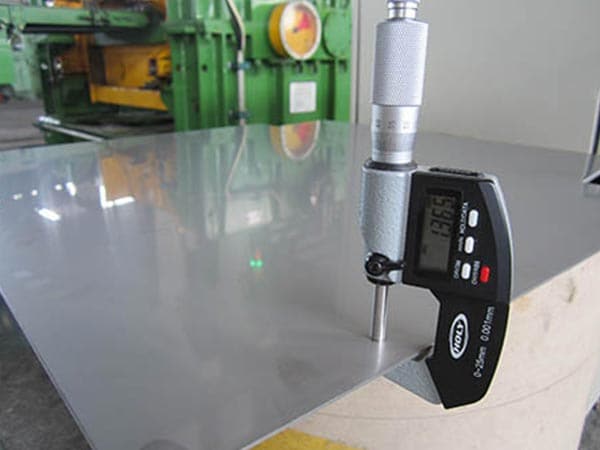
Dimensional testing involves high-precision measurement of thickness, width, and flatness. For high-speed automated manufacturing, even a minor deviation in flatness can cause significant downtime. Laser measurement systems are now frequently integrated into the rolling mills to provide real-time data on thickness consistency across the entire length of the coil or plate, ensuring compliance with EN 10051 or ASTM A568 tolerances.
Environmental and Fatigue Testing for Long-Term Durability
In specialized engineering projects, the steel may undergo Fatigue Testing to simulate the cyclic loading it will experience over its lifespan. This involves subjecting the steel to repeated stress cycles to determine its endurance limit. Furthermore, if the steel is destined for offshore or chemical environments, Corrosion Resistance Tests, such as salt spray testing or HIC (Hydrogen Induced Cracking) testing, might be requested, although these are more common for higher alloy grades.
The culmination of these tests is documented in the Mill Test Certificate (MTC), typically issued according to EN 10204 3.1. This document provides the customer with a complete history of the steel's chemical and mechanical profile, linked directly to the heat number of the furnace. This traceability is a fundamental requirement for ISO 9001 certified manufacturers and ensures that every ton of S355MC equivalent meets the global standards for excellence.
Advancing the Standards of Steel Verification
As manufacturing technology evolves, the testing of S355MC and its ASTM equivalents continues to incorporate more digital and automated solutions. From AI-driven surface defect detection to automated tensile testing stations, the focus remains on eliminating human error and providing a transparent, data-rich quality profile. By adhering to these comprehensive testing regimes, producers ensure that the steel not only meets the nominal requirements of the grade but also provides the safety margin necessary for the world's most demanding engineering challenges.
Leave a message