
10mm thickness structure steel plate s700m yield strength Mpa
Detailed technical analysis of 10mm thickness S700M structural steel plate, focusing on its 700 MPa yield strength, TMCP manufacturing, welding performance, and industrial weight-saving applications.
Understanding the S700M Structural Steel Specification
S700M represents a pinnacle in the evolution of thermomechanically rolled fine-grain structural steels. The designation itself reveals the core characteristics: 'S' stands for structural steel, '700' indicates a minimum yield strength of 700 MPa for thicknesses up to 16mm, and 'M' denotes the thermomechanical rolling delivery condition. For a 10mm thickness plate, this material offers an exceptional balance between extreme load-bearing capacity and relatively low mass, making it a preferred choice for modern engineering challenges where weight reduction is as critical as structural integrity.
The Metallurgy of 700 MPa Yield Strength
The 700 MPa yield strength of 10mm S700M is not achieved through high carbon content, which would compromise weldability. Instead, it relies on Thermomechanical Control Process (TMCP). This advanced rolling technique involves precise temperature control during the deformation process, followed by accelerated cooling. This results in an ultra-fine grain structure that effectively blocks dislocation movement within the metallic lattice, significantly raising the yield point without the brittleness associated with traditional quenching and tempering. In a 10mm section, the cooling rate is highly uniform, ensuring that the mechanical properties are consistent from the surface to the core of the plate.
Mechanical Performance and Material Constants
Beyond the primary yield strength, 10mm S700M plates exhibit a suite of mechanical properties designed for heavy-duty applications. The tensile strength typically ranges between 750 and 950 MPa. One of the most critical factors for engineers is the yield-to-tensile ratio, which remains high, providing a narrow but predictable safety margin before ultimate failure. Ductility is also preserved, with minimum elongation values usually around 12% for this thickness. This ensures that the steel can undergo significant deformation before fracturing, a vital characteristic for seismic-resistant structures and mobile machinery subjected to dynamic loads.
| Property | Value (10mm Thickness) | Unit |
|---|---|---|
| Minimum Yield Strength (Reh) | 700 | MPa |
| Tensile Strength (Rm) | 750 - 950 | MPa |
| Minimum Elongation (A5) | 12 | % |
| Impact Energy (Charpy-V, -20°C) | 40 | Joules |
| Density | 7.85 | kg/dm³ |
Chemical Composition and Weldability Advantages
The chemical profile of S700M is characterized by low carbon (often below 0.12%) and low alloy content, supplemented by micro-alloying elements like Niobium (Nb), Vanadium (V), and Titanium (Ti). This low Carbon Equivalent (CEV) is the secret behind its superior weldability. For a 10mm plate, the CEV typically stays below 0.39, which often eliminates the need for preheating during the welding process under standard conditions. This drastically reduces fabrication time and energy costs while minimizing the risk of cold cracking in the Heat Affected Zone (HAZ). Using matching or slightly under-matched consumables allows for joints that maintain the integrity of the 700 MPa design.
Processing and Fabrication: Bending and Cutting
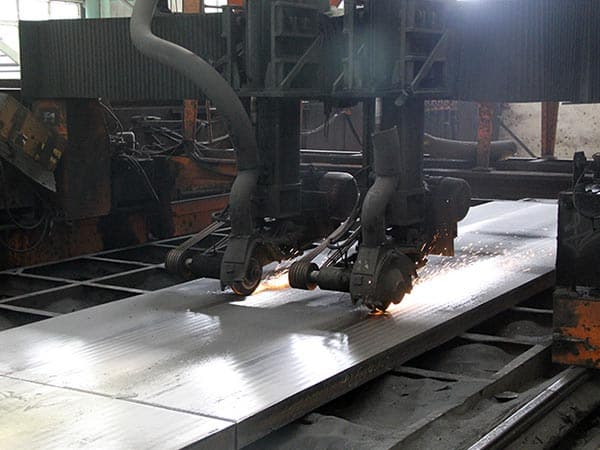
Working with 10mm S700M requires an understanding of its high-strength nature. When it comes to cold forming, the material allows for tight bending radii, typically around 2.0 to 3.0 times the thickness (20mm to 30mm for a 10mm plate), provided the bending is done perpendicular to the rolling direction. The fine-grain structure prevents surface cracking during these operations. For cutting, laser and plasma processes are highly effective. The low alloy content ensures a clean cut edge with minimal dross, which is essential for components that require high-precision fit-up before welding. Because the strength is derived from TMCP rather than heat treatment, localized heat from cutting has a negligible effect on the overall structural performance of the 10mm plate.
Weight Optimization in Mobile Equipment
The primary driver for selecting S700M over traditional S355 grades is weight optimization. By upgrading from a 20mm S355 plate to a 10mm S700M plate, an engineer can maintain similar load-carrying capacity while reducing the weight of the component by approximately 50%. This 'lightweighting' is transformative for the transport and lifting industries. In truck chassis, crane booms, and trailer frames, every kilogram saved translates directly into increased payload capacity, reduced fuel consumption, and lower carbon emissions over the vehicle's lifecycle. The 10mm thickness is particularly popular as it provides enough stiffness to prevent buckling while remaining light enough for rapid assembly.
Environmental Adaptability and Fatigue Resistance
S700M is engineered to perform in harsh environments. The 'M' grade specifies impact toughness testing, usually at -20°C, ensuring the material remains ductile even in cold climates. This is crucial for equipment operating in northern latitudes or offshore environments. Furthermore, the fine-grain structure inherent to TMCP steels provides excellent fatigue resistance. In structures subjected to cyclic loading, such as bridges or vibrating machinery, S700M resists the initiation and propagation of fatigue cracks better than coarser-grained steels of similar strength. This longevity reduces maintenance intervals and extends the total service life of the infrastructure.
Expanding Applications Across Industries
The versatility of 10mm S700M extends into various specialized sectors. In the renewable energy industry, it is used for high-stress components in wind turbine transport frames. In the mining sector, it serves as a robust material for conveyor systems and lightweight skip cars where abrasion resistance and high strength must coexist. The offshore industry utilizes S700M for topside structures where minimizing weight is essential for stability. As global standards push for more sustainable and efficient engineering, the adoption of 700 MPa yield strength steels continues to grow, replacing heavier, less efficient materials in the global supply chain.
Leave a message