
What is the difference between open flat and original strenx 700 equivalent
A technical comparison between original Strenx 700 plates and open flat equivalents, exploring mechanical properties, residual stress, and industrial performance.
Understanding the Pedigree: Strenx 700 vs. Open Flat Equivalents
In the world of high-strength structural steel, the name Strenx 700 represents a benchmark for performance, consistency, and reliability. However, when engineers and procurement specialists look for alternatives, they often encounter the term "open flat" equivalents. To understand the difference, one must first distinguish between the manufacturing origins. Original Strenx 700, produced by SSAB, is a thermomechanically rolled steel designed to offer high yield strength (700 MPa) combined with exceptional toughness and weldability. An "open flat" equivalent typically refers to S700MC steel that has been produced in a hot-rolled coil format and subsequently leveled and cut-to-length (decoiled) into flat sheets.
The fundamental difference lies not just in the chemical composition, which often aligns with EN 10149-2 standards, but in the internal stress state and dimensional precision. While both materials may technically meet the 700 MPa yield strength requirement, their behavior during secondary processes like laser cutting, bending, and welding can diverge significantly due to their different production paths.
The Decoiling Process and Residual Stress Dynamics
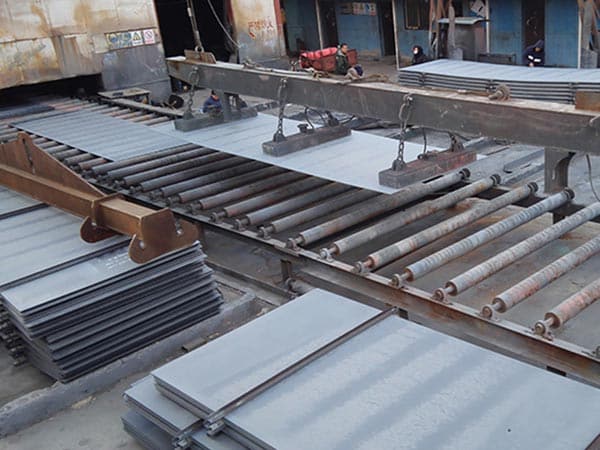
The term "open flat" refers to the mechanical transformation of a steel coil into a flat plate. During the hot-rolling process at the mill, the steel is wound into a tight coil while still relatively warm. As it cools in this coiled state, the material develops a "memory" or internal residual stress. When a service center "opens" this coil and flattens it using a leveling machine, they are applying mechanical force to counteract the coil set.
Original Strenx 700 plates, particularly those produced as Quarto plates (heavy plates), are rolled flat and stay flat throughout the cooling process. Even the Strenx sheets produced from coils undergo a proprietary leveling process that is often more rigorous than standard commercial decoiling. The result is that original Strenx products typically exhibit much lower residual stress. When an operator uses a laser or plasma cutter on an open flat equivalent, the heat can release the stored energy from the decoiling process, leading to bowing, twisting, or "springing up" of the parts. This can cause collisions with the cutting head and result in significant scrap rates.
Mechanical Property Comparison: S700MC vs. Strenx 700
While both materials are categorized under the S700MC designation (for cold forming), the "Original" Strenx 700 often exceeds the minimum requirements of the EN standards. The following table illustrates the typical comparative metrics between a standard open flat S700MC and the premium Strenx 700 equivalent.
| Property | Standard S700MC (Open Flat) | Original Strenx 700 / Laser Plus |
|---|---|---|
| Yield Strength (MPa) | 700 Min | 700 Min (Higher Consistency) |
| Tensile Strength (MPa) | 750 - 950 | 750 - 950 |
| Elongation (A5, %) | 12% - 14% | 13% - 15% |
| Flatness Tolerance | EN 10051 (approx. 6-10mm/m) | 3mm/m or better (Strenx Guarantee) |
| Impact Toughness | -20°C or -40°C (Optional) | Guaranteed at -40°C or -60°C |
The impact toughness is a critical differentiator. Original Strenx 700 is engineered for extreme environments, maintaining its ductility even at sub-zero temperatures. Many generic open flat equivalents are optimized for cost and may only guarantee toughness at -20°C, making them less suitable for mobile cranes or transport equipment operating in arctic conditions.
Fabrication Performance: Bending and Cold Forming
High-strength steel is notoriously difficult to bend because of its high yield-to-tensile ratio. The minimum bend radius is a vital specification for manufacturers of chassis, booms, and containers. Original Strenx 700 is famous for its tight bending radii, which are made possible by ultra-clean steel chemistry and precise control of the thermomechanical rolling process. This minimizes the risk of cracking on the outer radius of the bend.
- Consistency: Original Strenx provides a uniform thickness and hardness across the entire plate, ensuring that the "spring-back" after bending is predictable.
- Surface Quality: Open flat equivalents may sometimes show "coil breaks" or transverse fluting—visual defects caused by the decoiling process—which can act as stress concentrators during severe bending.
- Tooling Wear: The cleaner surface and controlled chemistry of premium Strenx 700 can lead to reduced wear on press brake dies compared to some lower-grade equivalents that may have inconsistent scale or surface inclusions.
Welding Characteristics and Heat Affected Zone (HAZ)
Both Strenx 700 and its high-quality open flat equivalents are designed for excellent weldability. Because they have a low carbon equivalent (CEV), they do not typically require preheating for standard thicknesses. However, the micro-alloying elements (such as Niobium, Vanadium, and Titanium) used to achieve the 700 MPa strength are sensitive to heat input.
In original Strenx 700, the grain structure is exceptionally fine. When welding, the Heat Affected Zone (HAZ) remains relatively narrow and maintains much of its strength. Some open flat equivalents, depending on the mill's cooling strategy, may experience more significant grain growth in the HAZ, leading to a localized drop in hardness and strength. For structural components where the weld joint is under high stress, the metallurgical stability of the original product provides an extra margin of safety.
Environmental Adaptability and Surface Protection
The environmental adaptability of these steels is largely dictated by their surface finish and chemical purity. Original Strenx 700 is often supplied with a very thin, tightly adherent scale or in a pickled and oiled condition. This surface is ideal for high-quality painting and coating systems. In contrast, open flat material can sometimes suffer from uneven scale due to the coiling and decoiling process, which might require more aggressive shot blasting before painting.
For industries like offshore energy or heavy mining, where corrosion resistance and fatigue life are paramount, the uniformity of the original plate's surface and its resistance to hydrogen-induced cracking (HIC) make it the preferred choice. The "open flat" equivalent might be perfectly adequate for indoor industrial racking or agricultural implements where the environmental stressors are less severe.
Industry-Specific Applications: Choosing the Right Grade
The choice between open flat equivalents and original Strenx 700 often comes down to the complexity of the final part. In heavy lifting and mobile cranes, weight reduction is the primary goal. Using Strenx 700 allows for thinner sections without sacrificing load capacity. Here, the precision and flatness of the original plate are non-negotiable because any deviation in the boom's straightness can lead to catastrophic failure under load.
In the transportation industry, specifically for trailer chassis and side panels, open flat S700MC is frequently used. These parts are often long and require the cost-efficiency of decoiled material. If the manufacturer has advanced leveling equipment and can manage the residual stresses, open flat equivalents offer a compelling economic advantage while still providing the necessary strength to reduce vehicle tare weight and increase payload.
Agricultural machinery manufacturers often sit in the middle. For complex laser-cut brackets and folded sections, they might prefer the reliability of original Strenx. For large, flat panels or simple structural beams, they might opt for the open flat equivalent to stay competitive on price.
Strategic Selection for Engineering Excellence
Selecting between these two options requires a deep understanding of the total cost of ownership. While open flat equivalents may have a lower initial purchase price per ton, the hidden costs of rework, scrap, and slower processing speeds due to material instability can quickly bridge the price gap. Engineers must evaluate whether their workshop is equipped to handle the residual stresses of decoiled steel. If high-precision laser cutting and tight-radius bending are central to the production process, the original Strenx 700 or its "Laser Plus" variants often prove to be more economical in the long run.
Ultimately, the "equivalent" status of S700MC is a statement of minimum mechanical capability, whereas "Original Strenx 700" is a promise of process optimization. By matching the material's stress state and dimensional tolerances to the specific requirements of the application, manufacturers can achieve the perfect balance between high-performance engineering and cost-effective production.
Leave a message