
What are the production technical requirements of 1.0976 hot-rolled steel
A technical deep dive into the production requirements for 1.0976 (S355MC) steel, covering chemical melting, thermomechanical rolling, and mechanical testing standards.
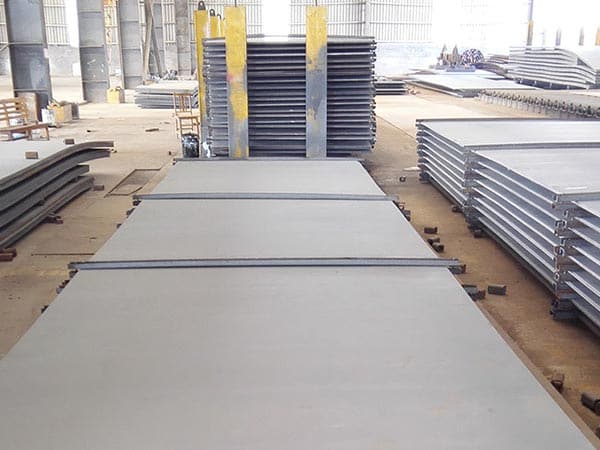
Understanding 1.0976 Steel Specifications
1.0976 steel, commonly known in the industry as S355MC according to the EN 10149-2 standard, belongs to the category of high-yield-strength steels for cold forming. Unlike standard carbon steels, this material requires a thermomechanically rolled (TMCP) process to achieve its mechanical properties. Engineers select 1.0976 for truck frames, cold-pressed parts, and structural sections where weight reduction matters without sacrificing load-bearing capacity.
Chemical Composition and Smelting Controls
The production starts in the Basic Oxygen Furnace (BOF) or Electric Arc Furnace (EAF). To meet the 1.0976 grade, the chemistry must stay within tight margins. The steel is fully killed, meaning oxygen is completely removed during the ladle metallurgy stage.
| Element | Maximum Content (%) |
|---|---|
| Carbon (C) | 0.12 |
| Manganese (Mn) | 1.50 |
| Silicon (Si) | 0.50 |
| Phosphorus (P) | 0.025 |
| Sulfur (S) | 0.020 |
| Aluminum (Al) | 0.015 (min) |
Micro-alloying is the core of 1.0976 production. Manufacturers add small amounts of Niobium (Nb), Vanadium (V), and Titanium (Ti). These elements pin the grain boundaries during the rolling process, preventing grain growth and ensuring a fine-grained microstructure. The sum of Nb, V, and Ti usually does not exceed 0.22%.
Refinement and Deoxidation
Ladle furnace (LF) treatment is mandatory. Operators must desulfurize the melt to reach levels below 0.010% if the customer requires high impact toughness. Calcium treatment is often used for inclusion shape control, turning elongated manganese sulfides into spherical shapes that do not crack during cold bending.
The Thermomechanical Rolling Process (TMCP)
The technical requirements for 1.0976 center on the rolling mill. You cannot achieve S355MC properties through simple hot rolling and air cooling. The process requires controlled deformation at specific temperature ranges.
Slab Reheating
Slabs enter the reheating furnace and must reach a temperature between 1150°C and 1250°C. This ensures all micro-alloying elements like Niobium are fully dissolved into the austenite matrix. If the slab stays too long in the furnace, the grains grow too large, ruining the final yield strength.
Roughing and Finishing Stages
The roughing mill breaks down the slab thickness. However, the finishing mill is where the metallurgy happens. The finishing temperature must be strictly controlled, typically above the Ar3 transformation point (around 850°C to 880°C). Rolling at these temperatures creates a high density of dislocations in the austenite, which then transform into very fine ferrite grains upon cooling.
Cooling Rate Control
After the final pass, the steel strip moves onto the run-out table. Laminar water cooling systems must quench the strip at a rate of 15°C to 30°C per second. The coiling temperature is usually set between 600°C and 650°C. This temperature allows for the precipitation of micro-alloy carbides, which provides the final boost in strength through precipitation hardening.
Mechanical Property Requirements
Quality control labs must verify that every coil meets the EN 10149-2 benchmarks. For 1.0976, the yield strength is the primary metric.
- Yield Strength (ReH): Minimum 355 MPa for thicknesses ≤ 16mm.
- Tensile Strength (Rm): 430 to 550 MPa.
- Elongation (A80/A5): Minimum 19% to 23% depending on the thickness and test direction.
Because this steel is designed for cold forming, the bend test is critical. A specimen of 1.0976 must withstand a 180-degree bend over a mandrel with a diameter 0.5 to 1.5 times the thickness of the plate without showing any cracks on the outer surface.
Dimensional Tolerances and Surface Quality
Production requirements extend to the physical dimensions of the hot-rolled coil. 1.0976 is often used in automated laser cutting and robotic welding cells, which demand high precision.
Thickness and Flatness
Tolerances must adhere to EN 10051. Modern mills use Automatic Gauge Control (AGC) to keep thickness variations within microns across the length of a 1000-meter coil. Flatness is equally vital; any "oil canning" or center buckles will cause issues during the uncoiling and leveling process at the fabricator's site.
Surface Finish
The surface must be free from slivers, heavy scale, and cracks. While hot-rolled steel naturally has a mill scale, it must be tight and uniform. If the steel is intended for painting or high-precision welding, it is often pickled and oiled (P&O) to remove the iron oxide layer and provide a clean metallic surface.
Testing and Certification
Each batch of 1.0976 requires a 3.1 inspection certificate according to EN 10204. This document tracks the heat number, the chemical analysis, and the mechanical test results. Impact testing (Charpy V-notch) is not always mandatory for S355MC unless specified by the buyer, but many mills perform it at -20°C or -40°C to prove the material's toughness in cold climates.
Common Production Challenges
Producing 1.0976 isn't without risks. If the finishing temperature drops too low, the steel develops a dual-phase structure that makes it brittle. If the cooling is uneven across the width of the strip, the coil will develop internal stresses, leading to "spring back" during cold forming. Engineers must balance the mill speed, water pressure, and alloy costs to hit the sweet spot of the 1.0976 specification.
Leave a message