
What is the BBNSteel company S900MC exporting product quality
Explore the rigorous quality standards of BBNSteel S900MC exporting products. This technical guide details the mechanical properties, chemical composition, processing capabilities, and industrial applications of S900MC HSLA steel.
The Technical Superiority of S900MC High-Strength Steel
S900MC is a high-strength low-alloy (HSLA) steel grade specifically designed for cold forming, produced through a sophisticated thermomechanical control process (TMCP). As a flagship product for BBNSteel's export division, S900MC adheres to the stringent requirements of the EN 10149-2 standard. The quality of exporting S900MC is defined not only by its minimum yield strength of 900 MPa but also by its exceptional balance of toughness, weldability, and formability. This material is engineered to meet the modern industrial demand for lightweight structures without compromising structural integrity or safety. For international buyers, BBNSteel ensures that every batch of S900MC undergoes rigorous testing to verify its performance in demanding environments, from arctic temperatures to high-stress mechanical cycles.
Chemical Composition and Micro-Alloying Precision
The quality of S900MC begins at the molecular level. BBNSteel utilizes advanced oxygen furnace refining and vacuum degassing to achieve a clean steel chemistry with extremely low impurity levels. The micro-alloying strategy is critical for achieving the high strength characteristic of this grade. Elements such as Niobium (Nb), Vanadium (V), and Titanium (Ti) are added in precise quantities to promote grain refinement and precipitation hardening. These elements pin the grain boundaries during the rolling process, preventing grain growth and resulting in a fine-grained microstructure that is essential for both strength and low-temperature impact toughness.
| Element | C (max) | Si (max) | Mn (max) | P (max) | S (max) | Al (min) | Nb+V+Ti (max) |
|---|---|---|---|---|---|---|---|
| Content (%) | 0.20 | 0.60 | 2.20 | 0.025 | 0.015 | 0.015 | 0.22 |
By maintaining a low carbon equivalent (CEV), BBNSteel S900MC offers superior weldability compared to traditional quenched and tempered steels of similar strength levels. This low CEV reduces the risk of cold cracking in the heat-affected zone (HAZ), allowing for more efficient fabrication processes in the workshop. The strict control over Sulfur and Phosphorus levels ensures that the steel maintains high internal cleanliness, which is vital for preventing lamellar tearing and improving the overall fatigue life of the exported components.
Mechanical Performance and Structural Integrity
The defining characteristic of BBNSteel's S900MC is its mechanical robustness. While the "900" in its name signifies a minimum yield strength of 900 MPa, the actual quality of the export product often exceeds these baseline requirements. The tensile strength typically ranges between 930 and 1200 MPa, providing a significant safety margin for engineering designs. Elongation values are carefully monitored to ensure that despite the high strength, the material retains enough ductility for complex forming operations. BBNSteel also provides optional impact testing at -20°C or -40°C, ensuring the steel can perform in extreme climatic conditions often encountered in global infrastructure projects.
- Yield Strength (ReH): Minimum 900 MPa for thicknesses up to 16mm.
- Tensile Strength (Rm): 930 - 1200 MPa.
- Elongation (A5): Minimum 7-8% depending on the thickness and rolling direction.
- Impact Energy: Typically 27J or 40J at specified sub-zero temperatures.
This high strength-to-weight ratio allows engineers to reduce the thickness of structural members by up to 50% compared to standard S355 structural steel. This reduction directly translates to lower material costs, reduced transportation energy, and increased payload capacity for mobile machinery, which is a primary driver for the global demand for BBNSteel S900MC.
Thermomechanical Control Process (TMCP) Excellence
The quality of S900MC is largely a product of the rolling mill's precision. Unlike conventional normalized steel, S900MC is produced using TMCP, where the final rolling temperature and cooling rate are strictly controlled. This process creates a very fine-grained ferrite and bainite microstructure. BBNSteel’s state-of-the-art rolling facilities utilize high-pressure descaling and automated thickness control (AGC) to ensure that the surface quality and dimensional tolerances of the exported plates meet or exceed international standards like EN 10051. The flatness of the plates is particularly critical for automated laser cutting and robotic welding, and BBNSteel employs advanced leveling machines to achieve superior flatness across the entire plate length.
Cold Forming and Fabrication Capabilities
One of the most significant advantages of BBNSteel S900MC is its cold forming capability. High-strength steels are often difficult to bend, but the fine-grained structure of S900MC allows for relatively tight bending radii. For export quality assurance, BBNSteel provides specific guidelines for bending to prevent cracking and minimize springback. For a plate thickness (t), the recommended minimum bending radius is typically 2.5t to 3.0t, depending on the orientation relative to the rolling direction. This makes it an ideal material for producing complex longitudinal beams, U-sections, and C-profiles used in the automotive and crane industries.
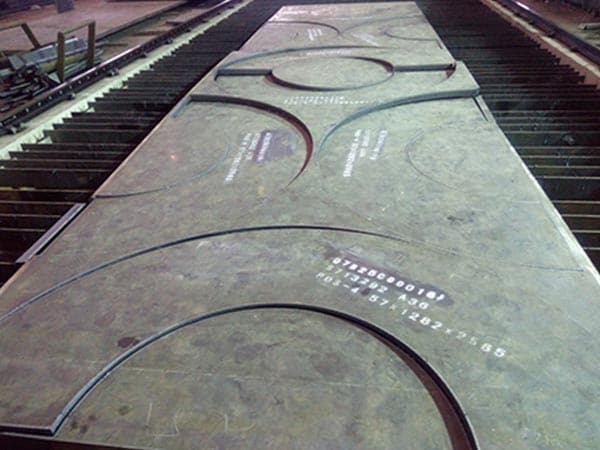
When fabrication involves cutting, S900MC responds exceptionally well to modern thermal cutting techniques. Laser cutting, in particular, produces clean edges with a very narrow heat-affected zone, preserving the mechanical properties of the steel near the cut. Plasma and waterjet cutting are also highly effective. BBNSteel ensures that the surface of the exported steel is free from heavy scale or defects that could interfere with the precision of CNC cutting equipment.
Advanced Welding Protocols
Welding S900MC requires an understanding of its metallurgical properties. Because it is a TMCP steel, excessive heat input can lead to softening in the heat-affected zone (HAZ). BBNSteel provides technical support to exporters regarding optimal welding parameters. The use of low-hydrogen consumables is mandatory to prevent hydrogen-induced cracking. Gas Metal Arc Welding (GMAW/MAG) is the most common method used, often with high-strength filler metals that match the base material's properties. By controlling the cooling time (t8/5), fabricators can maintain the high strength and toughness of the joint, ensuring the exported structure's overall reliability.
Strategic Applications in Global Industry
The export quality of BBNSteel S900MC makes it a preferred choice across various high-performance sectors. In the transport industry, it is used for the chassis of heavy-duty trucks and trailers, where reducing the dead weight is essential for fuel efficiency and payload optimization. In the lifting and construction sector, S900MC is the standard for telescopic crane booms and high-reach platforms, where the material must withstand immense stress while remaining lightweight. Other applications include forestry machinery, agricultural equipment, and high-rise structural components where space-saving through thinner, stronger sections is required.
BBNSteel’s commitment to quality extends to the logistics of exporting. Plates and coils are treated with anti-corrosion oils and wrapped in seaworthy packaging to ensure they arrive at international ports in pristine condition. Comprehensive documentation, including Mill Test Certificates (MTC) according to EN 10204 3.1 or 3.2, accompanies every shipment, providing full traceability from the raw material to the finished product. This transparency is a cornerstone of BBNSteel's reputation as a reliable global supplier of high-strength steel solutions.
Quality Assurance and International Standards
To maintain the highest export quality, BBNSteel implements a multi-stage inspection process. This includes ultrasonic testing (UT) to detect internal laminations, surface inspection to ensure no slivers or scales are present, and rigorous dimensional checks. The steel is produced in compliance with ISO 9001 quality management systems, ensuring consistency across different production lots. For specialized projects, BBNSteel can accommodate third-party inspections by agencies such as SGS, Bureau Veritas, or TUV, providing an additional layer of confidence for the end-user. The ability to meet custom requirements, such as specific plate widths or non-standard lengths, further enhances the value proposition of BBNSteel S900MC in the international market.
The integration of high-strength properties with excellent processing characteristics makes S900MC a versatile tool for modern engineering. As global regulations move towards more sustainable and efficient designs, the role of high-quality HSLA steels like S900MC becomes even more critical. BBNSteel continues to innovate in the TMCP space, refining the balance between strength and ductility to push the boundaries of what is possible in steel construction and machinery manufacturing.
Leave a message