
Alloy steel s550mc automotive steel coil equivalent astm 1inch size stock
Comprehensive guide to S550MC high-strength automotive steel. Explore mechanical properties, ASTM equivalents, welding techniques, and industrial applications for heavy-duty structural components.
Understanding S550MC: The Backbone of Modern Automotive Engineering
S550MC is a high-yield strength, thermomechanically rolled steel specifically designed for cold forming. As part of the EN 10149-2 standard, this grade represents a critical advancement in materials science, allowing manufacturers to reduce vehicle weight without compromising structural integrity. The "S" denotes structural steel, "550" indicates a minimum yield strength of 550 MPa, and "MC" signifies its thermomechanically rolled condition with a fine-grained microstructure.
For engineers and procurement specialists looking for S550MC automotive steel coil, understanding the nuances of its chemistry and mechanical behavior is essential. This material is not merely a commodity; it is a precision-engineered alloy that balances extreme strength with the ductility required for complex bending and shaping operations.
Mechanical Performance and Chemical Synergy
The performance of S550MC is derived from its unique micro-alloying strategy. By incorporating small amounts of Niobium (Nb), Titanium (Ti), and Vanadium (V), the steel achieves a refined grain structure during the thermomechanical rolling process. This refinement is what allows the material to maintain high toughness even at low temperatures.
| Property | Value (Metric) | Value (Imperial) |
|---|---|---|
| Minimum Yield Strength | 550 MPa | ~80,000 psi |
| Tensile Strength | 600 - 760 MPa | 87,000 - 110,000 psi |
| Minimum Elongation (A5) | 12% - 14% | 12% - 14% |
| Impact Energy (-20°C) | 40 J (Typical) | 29.5 ft-lb |
The chemical composition is strictly controlled to ensure weldability. Carbon content is typically kept below 0.12%, which significantly reduces the risk of cold cracking during welding processes. This low carbon equivalent (CEV) makes S550MC an ideal candidate for high-speed automated welding lines in the automotive sector.
S550MC Equivalent: Navigating ASTM Standards
In the North American market, finding an S550MC equivalent ASTM grade is a common requirement. While no two standards are identical, the closest match is generally found within the ASTM A1011 or ASTM A1018 specifications. Specifically, ASTM A1011 HSLAS-F Grade 80 Class 1 is frequently cited as the functional equivalent for thinner gauges, while ASTM A1018 Grade 80 is used for heavier sections.
- ASTM A1011 Grade 80: Offers a similar yield strength of 80 ksi and is designed for improved formability (the "F" in HSLAS-F).
- ASTM A656 Grade 80: Often used for structural plates where high strength-to-weight ratios are required in heavy equipment.
- JIS G3134 SPFH 590: The Japanese equivalent often found in automotive components for Asian-market vehicles.
When substituting S550MC with an ASTM grade, it is vital to verify the specific elongation and bending radius requirements, as European EN standards and American ASTM standards use different testing geometries (e.g., gauge length) which can lead to slight variations in reported ductility.
Processing 1-Inch Size Stock: Challenges and Capabilities
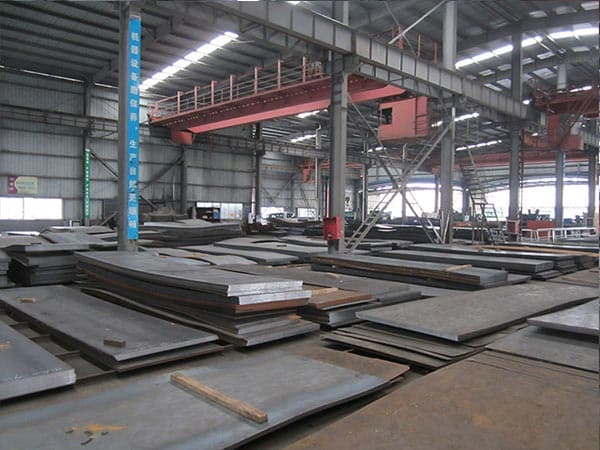
While S550MC is traditionally associated with thinner coils (2mm to 12mm), the demand for 1-inch size stock (approximately 25.4mm) has grown in heavy-duty transport and lifting sectors. Producing S550MC at this thickness requires specialized thermomechanical control processes (TMCP) to ensure the core of the plate achieves the same fine-grained structure as the surface.
Processing 1-inch S550MC involves several critical considerations:
- Cold Bending: Despite its thickness, S550MC retains excellent cold-forming properties. However, for 1-inch material, the minimum bending radius must be strictly followed (typically 1.5 to 2.0 times the thickness) to prevent surface fissuring.
- Laser Cutting: The low impurity content and consistent microstructure of S550MC make it exceptionally well-suited for high-power fiber laser cutting, resulting in clean edges with minimal heat-affected zones.
- Welding: Preheating is generally not required for S550MC even at 1-inch thicknesses, provided the environment is dry and the cooling rate is controlled. Using low-hydrogen consumables is mandatory to maintain the integrity of the high-strength joint.
Industrial Applications: Beyond the Chassis
The primary driver for S550MC consumption is the automotive industry, specifically for components like chassis frames, cross members, and suspension towers. However, its high strength-to-weight ratio has facilitated its expansion into other demanding sectors.
In the crane and lifting industry, S550MC is used for telescopic booms where weight reduction directly translates to increased lifting capacity. Similarly, in the agricultural sector, it is used for heavy-duty plow frames and trailer chassis that must withstand significant cyclic loading and abrasive environments.
The 1-inch thick stock is particularly valued in the construction of heavy-duty earthmoving equipment. By replacing traditional S355 structural steel with S550MC, manufacturers can reduce the plate thickness by nearly 30% while maintaining the same load-bearing capacity, leading to significant fuel savings and reduced carbon footprints for the end-user.
Environmental Adaptability and Surface Protection
S550MC is not a corrosion-resistant alloy in the same vein as stainless steel or weathering steel (like Corten). Therefore, surface protection is paramount for long-term durability. Due to its clean surface finish resulting from the pickling and oiling (P&O) process, S550MC provides an excellent substrate for various coatings.
- Hot-Dip Galvanizing: The low Silicon and Phosphorus content in S550MC ensures a uniform and predictable zinc coating, avoiding the brittle, thick coatings often seen in reactive steels.
- E-Coating: Standard in the automotive industry, S550MC's surface allows for superior adhesion of electrophoretic primers.
- Powder Coating: For industrial machinery, the smooth surface of cold-rolled or pickled S550MC ensures a high-quality aesthetic finish alongside functional protection.
Strategic Sourcing: Managing Stock and Lead Times
Maintaining a reliable supply of S550MC automotive steel coil requires a deep understanding of the global supply chain. Stock availability for 1-inch material is often more constrained than thinner gauges, as fewer mills have the rolling force capacity to maintain the TMCP requirements at that thickness. Working with a supplier who maintains a diverse inventory of both master coils and cut-to-length plates is crucial for just-in-time (JIT) manufacturing environments.
When evaluating stock, buyers should insist on full Mill Test Certificates (MTC) according to EN 10204 3.1. This documentation ensures that the specific heat of steel meets the rigorous yield and tensile requirements, as well as the chemical limits for micro-alloying elements that define the S550MC grade.
Technical Summary for Engineers
S550MC represents the optimal intersection of high-load capacity and ease of fabrication. Whether you are designing a lightweight truck chassis or a heavy-duty industrial crane, the transition to S550MC offers tangible benefits in terms of material cost savings (through weight reduction) and enhanced product performance. By aligning with the correct ASTM equivalents and understanding the processing parameters for 1-inch size stock, manufacturers can push the boundaries of what is possible in structural steel design.
Leave a message