
How about the cost performance of S700MC factory direct sales
Explore the comprehensive cost performance of S700MC high-strength steel through factory direct sales. This expert analysis covers mechanical properties, processing advantages, and economic benefits for heavy industry applications.
The Technical Foundation and Market Value of S700MC High-Strength Steel
In the modern industrial landscape, the pursuit of lightweighting and high structural efficiency has pushed S700MC into the spotlight. As a high-strength low-alloy (HSLA) steel produced through thermo-mechanically controlled processing (TMCP), S700MC offers a unique balance of extreme yield strength and excellent formability. When evaluating the cost performance of factory direct sales, one must look beyond the initial price per ton and consider the lifecycle value, processing savings, and structural optimization it enables. Factory direct procurement eliminates intermediary markups while ensuring that the material's sophisticated metallurgical properties are fully documented and traceable.
Metallurgical Excellence: The TMCP Advantage
S700MC is defined by the EN 10149-2 standard, which specifies hot-rolled flat products made of high yield strength steels for cold forming. The 'MC' suffix denotes a thermomechanically rolled material, a process that refines the grain structure far more effectively than traditional normalizing. By precisely controlling the temperature and deformation during the rolling process, manufacturers can achieve a yield strength of 700 MPa without the need for heavy alloying elements. This results in a material that is not only strong but also exceptionally clean and weldable. The micro-alloying elements, typically Niobium (Nb), Vanadium (V), and Titanium (Ti), are used in minute quantities to prevent grain growth and promote precipitation hardening.
| Chemical Element | Maximum Content (%) |
|---|---|
| Carbon (C) | 0.12 |
| Manganese (Mn) | 2.10 |
| Silicon (Si) | 0.60 |
| Phosphorus (P) | 0.025 |
| Sulfur (S) | 0.015 |
| Aluminium (Al) | 0.015 |
The low carbon content (max 0.12%) is a critical factor in its cost performance. Lower carbon equates to a lower carbon equivalent (CEV), which directly translates to superior weldability. In a factory direct sales model, buyers can often request specific chemical tolerances that further optimize the steel for specialized welding robots or high-speed automated production lines.
Mechanical Properties and Structural Efficiency
The primary driver of S700MC's cost-effectiveness is its high yield strength-to-weight ratio. By replacing traditional S355 structural steel with S700MC, engineers can reduce the thickness of components by up to 30-40% without sacrificing load-bearing capacity. This weight reduction has a cascading effect on cost performance: less material purchased, lower shipping costs, and significantly higher payloads for transport vehicles.
| Property | Value (Thickness ≤ 16mm) |
|---|---|
| Yield Strength (ReH) | Min. 700 MPa |
| Tensile Strength (Rm) | 750 - 950 MPa |
| Elongation (A80mm) | Min. 10% - 12% |
| Min. Bending Radius (90°) | 1.0t to 1.5t (depending on thickness) |
Beyond the static strength, S700MC exhibits remarkable impact toughness at low temperatures. While standard grades might become brittle in cold climates, S700MC maintains its integrity, making it a preferred choice for mobile cranes and trailers operating in diverse environmental conditions. Factory direct sales ensure that these mechanical properties are verified through rigorous testing (e.g., Charpy V-notch tests), providing the reliability required for safety-critical components.
Processing Performance: Bending and Cutting
One of the most significant advantages of S700MC is its cold-forming capability. Despite its high strength, the fine-grained structure allows for tight bending radii. This is particularly valuable in the manufacturing of complex chassis members and U-beams. Using S700MC reduces the risk of cracking during the bending process, provided the manufacturer's guidelines regarding the direction of rolling are followed. For thicknesses under 3mm, an internal bending radius of 1.0 times the thickness is often achievable, which is exceptional for a 700 MPa steel.
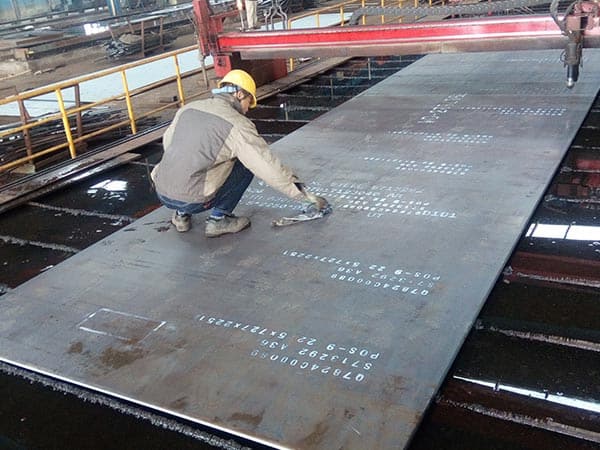
When it comes to cutting, S700MC performs excellently under laser, plasma, and waterjet systems. The low level of internal stress—a byproduct of the TMCP process—ensures that the plates remain flat after cutting, reducing the need for secondary leveling operations. This dimensional stability is a hidden cost-saver that significantly boosts the throughput of fabrication shops. Factory direct sourcing allows for the procurement of custom lengths and widths, further minimizing scrap rates and optimizing material nesting during the cutting phase.
Welding Dynamics and Integrity
Welding S700MC requires an understanding of its metallurgical profile. Because it relies on grain refinement rather than high alloy content, it is sensitive to excessive heat input. However, its low carbon equivalent means that preheating is generally unnecessary for most thicknesses, which is a major cost advantage over quenched and tempered steels like S690QL. Maintaining a controlled cooling rate is essential to preserve the strength of the Heat Affected Zone (HAZ).
- Low heat input (typically 0.5 to 1.5 kJ/mm) is recommended to prevent grain coarsening.
- Matching or slightly under-matching filler materials can be used depending on the joint design and stress requirements.
- The excellent surface quality of factory-direct S700MC, often with minimal scale, improves weld pool stability and reduces post-weld cleaning time.
Economic Analysis: The Factory Direct Advantage
The cost performance of S700MC is maximized through factory direct sales for several reasons. First, the removal of the middleman reduces the "transactional friction" and markups that can add 10% to 20% to the material cost. Second, direct communication with the mill allows for technical consultation, ensuring the right grade and surface finish are selected for the specific application. Third, large-scale projects benefit from synchronized delivery schedules, reducing inventory holding costs.
From a design perspective, the "cost per MPa" of S700MC is often lower than that of S355 when the total volume of steel is considered. For instance, in a trailer frame, using thinner S700MC plates reduces the total weight of the vehicle. This not only saves on the initial material purchase but also provides the end-user with lower fuel consumption and higher freight revenue over the vehicle's 10-year lifespan. This long-term economic benefit is the true measure of S700MC's cost performance.
Industrial Applications and Environmental Impact
S700MC is widely utilized in the transportation sector, particularly for truck chassis, trailers, and tanker supports. In the lifting industry, it is the standard for telescopic crane booms where weight reduction at height is critical for stability. Furthermore, the agricultural sector uses S700MC for heavy-duty plows and harvesters that must withstand high stress while remaining light enough to minimize soil compaction.
The environmental aspect cannot be ignored. Using less steel to achieve the same structural performance reduces the carbon footprint of the manufacturing process. Furthermore, the increased fuel efficiency of lighter vehicles contributes to lower CO2 emissions during the operational phase. As global industries move toward green manufacturing, S700MC provides a path to sustainability that is also economically viable. Factory direct sales often come with detailed environmental product declarations (EPD), helping companies meet their ESG goals.
Strategic Procurement and Quality Assurance
Choosing factory direct sales for S700MC ensures that the material meets the exact specifications required for high-performance engineering. Quality assurance is handled at the source, with Mill Test Certificates (MTC) providing a transparent record of the heat number, chemical analysis, and mechanical testing results. This level of traceability is vital for industries like mining and heavy construction, where material failure can lead to catastrophic results.
Ultimately, the cost performance of S700MC is a synergy of material science and supply chain efficiency. By leveraging its high strength to reduce weight, its excellent formability to simplify production, and factory direct pricing to minimize costs, manufacturers can produce superior products that are competitive in a global market. The transition from conventional structural steels to S700MC represents a strategic shift toward high-efficiency engineering that pays dividends throughout the product's entire existence.
Leave a message