
Main factors affecting s460mc mechanical properties price
Explore the critical factors influencing S460MC steel's mechanical properties and its market pricing, covering chemical composition, TMCP processing, and industry applications.
Decoding S460MC: The Intersection of High-Performance Engineering and Market Value
S460MC is a high-strength, hot-rolled, thermomechanically rolled steel specifically designed for cold forming. Governed by the EN 10149-2 standard, this material has become a cornerstone in modern engineering where weight reduction and structural integrity are paramount. Understanding the price fluctuations of S460MC requires a deep dive into the technical nuances that define its mechanical properties. It is not merely a commodity; it is a precision-engineered product whose cost is inextricably linked to its metallurgical complexity and the rigorous processing it undergoes.
Chemical Composition: The Foundation of Performance and Cost
The mechanical excellence of S460MC begins at the molecular level. Unlike standard carbon steels, S460MC relies on a sophisticated micro-alloying strategy. The balance of elements directly impacts both the yield strength and the manufacturing cost.
- Carbon (C) Content: Kept intentionally low (usually below 0.12%) to ensure excellent weldability and toughness. Low carbon reduces the risk of cold cracking but requires other elements to maintain strength, which adds to the cost.
- Manganese (Mn): Acting as a primary strengthener, Manganese enhances hardenability. Fluctuations in the global manganese ore market directly impact the base price of S460MC.
- Micro-alloying Elements (Nb, V, Ti): Niobium, Vanadium, and Titanium are added in minute quantities to facilitate grain refinement. These elements are expensive, and their precise dosage is critical for achieving the minimum 460 MPa yield strength.
- Sulfur and Phosphorus Control: To ensure high ductility and impact resistance, S460MC requires extremely low levels of impurities. The refining process needed to achieve these 'clean steel' standards increases energy consumption and production time.
| Element | Max % (EN 10149-2) | Role in S460MC Performance |
|---|---|---|
| Carbon (C) | 0.12 | Ensures weldability and prevents brittleness. |
| Manganese (Mn) | 1.60 | Increases tensile strength and hardness. |
| Silicon (Si) | 0.50 | Acts as a deoxidizer and improves strength. |
| Niobium (Nb) | 0.09 | Promotes grain refinement during rolling. |
| Titanium (Ti) | 0.15 | Prevents grain growth at high temperatures. |
The TMCP Process: Why Manufacturing Method Dictates Price
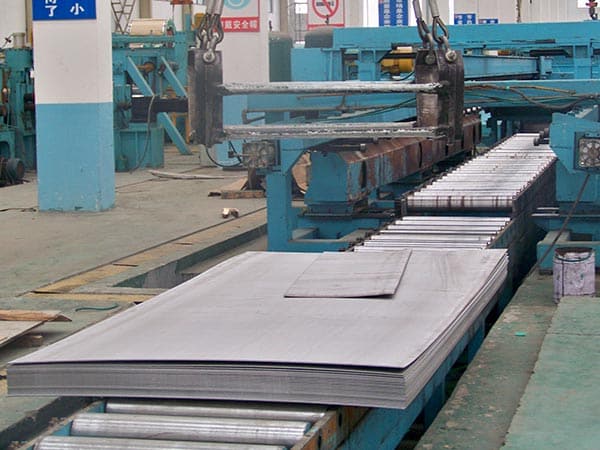
S460MC is produced via Thermo-Mechanical Controlled Processing (TMCP). This is not a standard rolling procedure; it involves strict control over the heating temperature, the deformation schedule, and the cooling rate. The 'MC' in S460MC stands for 'Thermomechanically Rolled,' a process that creates a fine-grained microstructure without the need for subsequent heat treatment.
This process requires high-end rolling mills equipped with advanced cooling systems. The capital expenditure for such machinery and the electricity required for high-pressure cooling are significant contributors to the final price. However, the result is a material with a superior strength-to-weight ratio, allowing engineers to use thinner sections, which ultimately saves total project costs despite a higher price per ton.
Mechanical Properties and Their Economic Implications
The price of S460MC is often justified by its reliable mechanical benchmarks. When a supplier guarantees these properties, they are accounting for the risk of material rejection and the cost of extensive testing.
- Yield Strength: A minimum of 460 MPa is mandatory. Maintaining this consistency across different batches requires tight process control.
- Tensile Strength: Ranging between 520 and 670 MPa, this property ensures the material can withstand significant loads before failure.
- Elongation: High ductility (minimum 14-17% depending on thickness) allows for complex cold forming and bending without cracking.
- Impact Toughness: While not always specified in basic S460MC, many high-end variants offer guaranteed impact values at -20°C or -40°C, which adds a premium to the price.
Cold Forming and Weldability: Operational Efficiency
From a manufacturing perspective, the 'value' of S460MC extends beyond its purchase price. Its excellent cold-forming properties mean that it can be bent into complex shapes with tight radii, reducing the need for multiple welded joints. This reduces labor costs and improves the structural integrity of the final product.
Furthermore, the low carbon equivalent (CEV) of S460MC makes it exceptionally easy to weld using standard methods like MIG, TIG, or submerged arc welding. The absence of a need for pre-heating or post-weld heat treatment (PWHT) in many applications provides a massive operational cost saving, which offsets the higher initial material cost compared to S355 or S235 grades.
Environmental Adaptability and Longevity
S460MC exhibits remarkable resilience in diverse environments. Its fine-grained structure provides a natural resistance to fatigue, making it ideal for dynamic loading conditions found in the transportation and heavy machinery sectors. While it is not a 'weathering steel' like Corten, its clean chemistry provides a better substrate for galvanizing or high-performance coating systems. The longevity of a structure built with S460MC reduces the total cost of ownership, a factor that savvy procurement officers prioritize over the spot price of the raw material.
Industry Applications Driving Demand
The pricing of S460MC is also a function of demand from specific high-tech industries. As these sectors grow, the pressure on supply chains can cause price spikes.
- Automotive Industry: Used for truck chassis, cross members, and suspension parts where weight reduction is critical for fuel efficiency.
- Crane and Lifting Equipment: High strength allows for longer boom lengths and higher lifting capacities without increasing the dead weight of the machine.
- Agricultural Machinery: Combines and tractors utilize S460MC for structural frames that must endure harsh, vibrating environments.
- Cold Pressed Profiles: Manufacturers of complex profiles use S460MC because it maintains its properties even after significant deformation.
Market Dynamics: Supply Chain and Logistics
Global steel prices are influenced by iron ore prices, scrap metal availability, and energy costs. For S460MC, the specialized nature of its production means only a limited number of Tier-1 mills can produce it to high-quality standards. This creates a more consolidated market compared to commodity grades. Additionally, the thickness of the plate or coil affects the price; thinner gauges often command a premium due to the increased rolling time and precision required to maintain flatness and mechanical uniformity.
Logistics also play a role. Because S460MC is often used in 'just-in-time' manufacturing environments (like automotive assembly lines), the cost of storage, protection against oxidation, and rapid transport are factored into the final quote provided by stockholders and distributors.
Strategic Procurement of S460MC
To optimize the cost-to-performance ratio, buyers should look beyond the price per kilogram. Evaluating the mill's certification, the consistency of the chemical analysis, and the precision of the dimensional tolerances can lead to significant savings during the fabrication process. A cheaper batch of S460MC that suffers from 'springback' during bending or inconsistent hardness can lead to expensive downtime and tool wear, far outweighing any initial savings.
Investing in high-quality S460MC is a strategic decision that leverages advanced metallurgy to achieve lighter, stronger, and more durable engineering solutions. As global standards move toward sustainability and efficiency, the role of high-strength steels like S460MC will only become more prominent, and its price will continue to reflect the sophisticated technology embedded within every ton.
Leave a message