
Can you heat treat S315MC large excavator steel plate?
A professional analysis of S315MC steel plate properties, focusing on why traditional heat treatment is not recommended for this TMCP-processed material in excavator manufacturing.
Understanding S315MC Microstructure and the TMCP Process
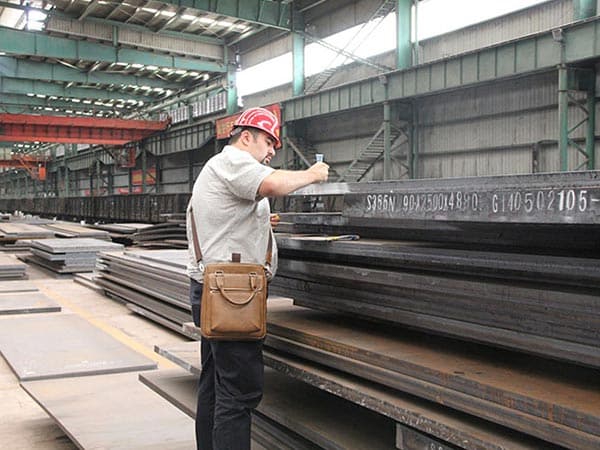
S315MC is a high-yield-strength steel designed specifically for cold forming, governed by the EN 10149-2 standard. To answer the core question: traditional heat treatment such as normalizing or quenching and tempering is generally not recommended for S315MC. The reason lies in its manufacturing origin. S315MC is produced through Thermomechanically Controlled Processing (TMCP). Unlike conventional hot-rolled steels that achieve their properties through chemistry alone or subsequent heat cycles, TMCP steels gain their exceptional strength and toughness through a combination of precise micro-alloying and strictly controlled rolling temperatures and cooling rates.
Why Traditional Heat Treatment Can Be Detrimental
When a large excavator steel plate made of S315MC is subjected to post-delivery heat treatment, specifically heating it above the AC1 transformation temperature (typically around 700°C to 900°C), the carefully engineered fine-grain structure is destroyed. The micro-alloying elements like Niobium (Nb), Vanadium (V), and Titanium (Ti) are designed to inhibit grain growth during the rolling process. Reheating the plate causes these grains to coarsen significantly. This leads to a drastic reduction in yield strength and, more critically, a loss of impact toughness. For heavy machinery like excavators, which operate under dynamic loads and varying temperatures, this loss of structural integrity is unacceptable.
Mechanical Properties and Material Composition
The excellence of S315MC in heavy equipment stems from its balanced chemical profile and mechanical performance. Below is a detailed breakdown of its typical properties:
| Property Type | Element/Parameter | Value (Typical) |
|---|---|---|
| Chemical Composition (%) | Carbon (C) | ≤ 0.12 |
| Chemical Composition (%) | Manganese (Mn) | ≤ 1.30 |
| Chemical Composition (%) | Silicon (Si) | ≤ 0.50 |
| Chemical Composition (%) | Al + Ti + Nb + V | Micro-alloyed |
| Mechanical | Yield Strength (MPa) | ≥ 315 |
| Mechanical | Tensile Strength (MPa) | 390 - 510 |
| Mechanical | Elongation (%) | ≥ 20 |
Stress Relieving: The Only Permissible Thermal Cycle
While full heat treatment is off the table, stress relieving is sometimes necessary after intensive welding or heavy cold forming in excavator chassis construction. If stress relieving is required, it must be performed at temperatures strictly below 580°C. Exceeding this limit risks the precipitation of alloying elements in a way that embrittles the steel. Engineers must ensure that the soaking time is kept to the minimum required to redistribute internal stresses without altering the ferrite-pearlite grain matrix established during the TMCP stage.
Superior Weldability for Excavator Fabrication
One of the primary reasons S315MC is selected for large excavator components—such as the boom, arm, and main frame—is its low Carbon Equivalent (CEV). Because the strength is derived from grain refinement rather than high carbon content, the steel exhibits excellent weldability. It can be welded using standard processes like GMAW (Gas Metal Arc Welding) or SAW (Submerged Arc Welding) without the need for preheating in most thickness ranges. This efficiency in the workshop is a major cost-saver for heavy equipment manufacturers. However, care must be taken with heat input; excessive heat during welding can create a softened Heat Affected Zone (HAZ), which is essentially a localized form of unwanted heat treatment.
Cold Forming Advantages and Process Limits
S315MC is optimized for cold forming. In the production of excavator structural parts, plates are often bent to form U-channels or box sections. The steel's high ductility allows for tight bending radii without cracking.
- Bending Radius: For thicknesses (t) ≤ 3mm, the minimum bending radius is 0.25t.
- Springback: Due to its consistent yield strength, springback is predictable, allowing for high-precision automated bending.
- Surface Quality: The fine-grain structure ensures a smooth surface after forming, which is ideal for the high-quality paint finishes required for construction machinery.
Environmental Adaptability and Fatigue Resistance
Large excavators often work in extreme environments, from sub-zero mining sites to tropical construction zones. S315MC maintains its impact strength at lower temperatures better than standard structural steels. Its fine-grained microstructure acts as a barrier to crack propagation, which is vital for the fatigue life of an excavator's moving parts. By avoiding traditional heat treatment, manufacturers preserve this natural resistance to cyclic loading and vibration, ensuring the machine's service life spans decades rather than years.
Strategic Application in Heavy Machinery
The transition from traditional hot-rolled plates to S315MC allows for significant weight reduction in excavator designs. By utilizing a higher strength-to-weight ratio, designers can reduce the thickness of non-critical plates while maintaining the structural safety factor. This leads to better fuel efficiency and higher lifting capacities. Beyond the excavator industry, this material is increasingly utilized in the manufacturing of mobile cranes, truck chassis, and agricultural equipment where the same principles of cold forming and high-strength durability apply. Manufacturers should focus on optimizing their welding and cold-forming parameters rather than attempting to modify the material's properties through heat cycles.
Leave a message