
How to calculate S550MC steel for car parts weight
Discover the precise methods for calculating S550MC steel weight in automotive part design. This guide covers mechanical properties, density factors, and optimization strategies for lightweighting.
Fundamentals of S550MC High-Strength Steel in Automotive Engineering
S550MC is a high-strength low-alloy (HSLA) steel grade specifically designed for cold-forming applications in the automotive industry. Governed by the EN 10149-2 standard, this thermomechanically rolled steel offers a unique balance of high yield strength and excellent formability. When engineers ask how to calculate S550MC steel for car parts weight, they are often looking beyond simple arithmetic; they are seeking to optimize the mass-to-performance ratio of critical structural components.
The primary driver for using S550MC is lightweighting. By utilizing a material with a minimum yield strength of 550 MPa, designers can reduce the thickness of components without compromising structural integrity. This reduction in gauge directly translates to lower vehicle weight, improved fuel efficiency, and reduced CO2 emissions. Understanding the precise weight calculation involves analyzing the material's physical density, the geometry of the part, and the manufacturing tolerances inherent in high-strength steel production.
The Core Formula for S550MC Weight Calculation
The fundamental calculation for the weight of any steel part, including those made from S550MC, relies on the physical property of density. For carbon steel and HSLA grades like S550MC, the standard density used in engineering calculations is 7.85 g/cm³ (or 7850 kg/m³).
The basic formula is: Weight (kg) = Volume (m³) × Density (kg/m³).
For a flat sheet or a simple stamped part, the calculation expands to:
- Weight (kg) = Length (m) × Width (m) × Thickness (mm) × 7.85
- For example, an S550MC plate measuring 2 meters by 1 meter with a thickness of 3mm would weigh: 2 × 1 × 3 × 7.85 = 47.1 kg.
However, in automotive manufacturing, parts are rarely simple rectangles. Complex geometries such as chassis cross-members, seat frames, and bumper reinforcements require more sophisticated volumetric analysis. Modern CAD (Computer-Aided Design) software automates this by calculating the exact volume of the 3D model and multiplying it by the defined material density of 7.85 g/cm³.
Mechanical Properties and Their Influence on Weight Reduction
The reason S550MC is favored over standard structural steels like S355MC is its superior mechanical profile. To accurately calculate the weight benefits, one must compare the performance metrics that allow for thinner gauges.
| Property | S550MC Value | Impact on Weight Calculation |
|---|---|---|
| Minimum Yield Strength | 550 MPa | Allows for thinner wall sections while maintaining load capacity. |
| Tensile Strength | 600 - 760 MPa | Ensures high energy absorption during crash events. |
| Minimum Elongation (A80mm) | 12% - 14% (depending on thickness) | Facilitates complex shapes without material failure. |
| Bending Radius (180°) | 0.5t to 1.5t | Enables tight packaging and optimized structural geometry. |
By shifting from a 4.0mm S355MC component to a 2.8mm S550MC component, a weight saving of approximately 30% can be achieved while maintaining the same yield load. This "down-gauging" is the most effective way to reduce car part weight through material selection.
Advanced Factors: Nesting, Scrap, and Tolerance
Calculating the weight of a finished car part is only one aspect of the procurement process. For cost estimation and logistics, engineers must calculate the Gross Weight versus the Net Weight.
Nesting Efficiency: Automotive parts are stamped from large coils or sheets. The layout of these parts on the sheet (nesting) determines the amount of scrap. S550MC's consistent mechanical properties allow for tighter nesting and more aggressive stamping, but a typical scrap rate of 15% to 30% must be factored into the raw material weight calculation.
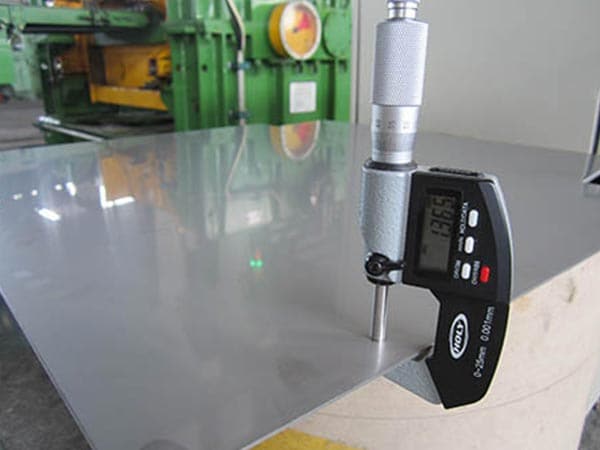
Thickness Tolerances: According to EN 10051, hot-rolled wide strip (the common form for S550MC) has specific thickness tolerances. If a designer specifies 3.0mm, the actual delivered material might be 3.05mm. While seemingly small, across a production run of 100,000 vehicles, this 1.6% increase in thickness results in significant unintended weight gain and cost. Precision weight calculation must account for these "nominal vs. actual" variations.
Processing Performance and Weight Optimization
The weight of an S550MC part is also influenced by how it is processed. The grade's excellent weldability and cold-forming characteristics allow for integrated designs that reduce the number of fasteners and reinforcements.
- Welding: S550MC has a low carbon equivalent, making it ideal for laser welding and arc welding. By using tailored blanks (joining different thicknesses of S550MC before stamping), engineers can place weight only where it is needed for strength.
- Cold Forming: The fine-grained microstructure of S550MC allows for complex bends. This means a single complex stamped part can replace an assembly of three smaller parts, eliminating the weight of overlapping joints and weld metal.
- Surface Treatment: S550MC parts are often E-coated or galvanized. While the weight of the coating is negligible for a single part (usually measured in microns), it is factored into high-precision mass simulations for electric vehicles (EVs) where every gram impacts range.
Environmental Adaptation and Lifecycle Weight Analysis
S550MC is increasingly used in the chassis and suspension systems of commercial vehicles and passenger cars due to its environmental resilience. High-strength steel provides better fatigue resistance than lower-grade steels, meaning parts do not need to be over-engineered (made heavier) to survive a 10-year lifecycle.
Furthermore, the recyclability of S550MC is a major advantage over composite materials or certain aluminum alloys. When calculating the "environmental weight" or carbon footprint, S550MC offers a lower CO2-per-kg-of-strength ratio compared to many alternatives. The ability to use less material (down-gauging) combined with 100% recyclability makes it a cornerstone of sustainable automotive design.
Industry Applications: Where S550MC Weight Savings Matter Most
In the heavy truck industry, S550MC is the standard for longitudinal beams and cross-members. For a trailer chassis, switching to S550MC can reduce the frame weight by several hundred kilograms, directly increasing the payload capacity. In passenger cars, it is found in:
- Seat Tracks and Frames: Where high strength is required for safety but low weight is needed for seat adjustment ease.
- Bumper Beams: Utilizing the high tensile strength to absorb impact energy while keeping the front-end weight low for better handling.
- Chassis Subframes: Providing the stiffness required for suspension mounting points without the bulk of traditional cast iron or thick-gauge mild steel.
Accurate weight calculation for these parts involves simulating dynamic loads to ensure that the chosen S550MC thickness meets safety standards while hitting the target mass. By integrating the material's 7.85 g/cm³ density with its 550 MPa yield strength in FEA (Finite Element Analysis) software, engineers can iterate designs until the absolute minimum weight is achieved.
Leave a message