
How to protect the 1.8969 high yield strength alloy quality steel from cracking
Comprehensive technical guide on preventing cracks in 1.8969 high yield weathering steel through advanced welding, heat treatment, and environmental management.
Understanding the Structural Integrity of 1.8969 High Yield Weathering Steel
1.8969 steel, often classified under the EN 10025-5 standard as S355J2W, represents a pinnacle of atmospheric corrosion-resistant structural steel. This high-yield strength alloy is engineered to form a protective 'patina' layer when exposed to the elements, effectively halting further oxidation. However, its sophisticated chemical composition, while providing excellent durability, introduces specific challenges regarding structural integrity—most notably the risk of cracking during fabrication, welding, and service life.
Protecting 1.8969 from cracking requires a deep dive into its metallurgical properties. Unlike standard carbon steels, the addition of chromium, copper, nickel, and phosphorus enhances its weather resistance but also alters its hardenability and weldability. Cracking in this material is rarely a result of a single factor; it is typically a synergy of residual stresses, hydrogen embrittlement, and improper thermal cycles. To maintain the quality of 1.8969, engineers must implement a holistic strategy spanning from material selection to final surface treatment.
Chemical Composition and Its Influence on Crack Sensitivity
The chemical blueprint of 1.8969 is the primary determinant of its mechanical behavior. The carbon equivalent (CEV) value is a critical metric here. A higher CEV indicates a greater risk of forming martensite in the heat-affected zone (HAZ) during welding, which is inherently brittle and prone to cold cracking.
| Element | Typical Percentage (%) | Role in Crack Prevention/Sensitivity |
|---|---|---|
| Carbon (C) | ≤ 0.16 | Maintains weldability while ensuring strength. |
| Manganese (Mn) | 0.50 - 1.50 | Increases toughness but affects CEV. |
| Chromium (Cr) | 0.40 - 0.80 | Enhances corrosion resistance; increases hardenability. |
| Copper (Cu) | 0.25 - 0.55 | Promotes patina formation; can cause hot shortness if not balanced. |
| Phosphorus (P) | ≤ 0.035 | Improves corrosion resistance but can increase cold shortness. |
Controlling the Carbon Equivalent: For 1.8969, maintaining a low CEV is essential for reducing the risk of Hydrogen-Induced Cracking (HIC). When the CEV exceeds 0.45, preheating becomes mandatory. Using low-hydrogen consumables and ensuring the base metal is free from moisture, oil, and rust are fundamental steps in preventing hydrogen atoms from diffusing into the steel lattice.
Advanced Welding Protocols to Mitigate Cracking
Welding is the most common stage where cracks appear in 1.8969 steel. The combination of thermal expansion and contraction, coupled with the alloy's specific hardening characteristics, necessitates precise control over the welding process. Cold cracking and lamellar tearing are the two primary threats.
- Preheating Strategies: Preheating the 1.8969 plate to between 100°C and 200°C (depending on thickness) slows the cooling rate. This prevents the formation of hard, brittle microstructures like martensite in the HAZ.
- Interpass Temperature Control: Keeping the interpass temperature within a specified range (typically not exceeding 250°C) ensures that the grain structure remains refined, preserving the steel's notch toughness.
- Low Hydrogen Electrodes: Utilizing basic-coated electrodes or flux-cored wires with hydrogen levels below 5ml/100g of weld metal is non-negotiable for high-yield alloys like 1.8969.
- Welding Sequence: Adopting a symmetrical welding sequence helps distribute residual stresses more evenly, preventing the concentration of stress at the root of the weld which often leads to longitudinal cracks.
Furthermore, the use of matching filler metals is vital. Since 1.8969 is a weathering steel, the weld metal must also contain similar levels of Cu and Cr to ensure the corrosion resistance of the joint matches the base metal. If the weld corrodes faster than the plate, the resulting pit can act as a stress concentrator, leading to fatigue cracking over time.
Mechanical Performance and Ductility Considerations
The high yield strength of 1.8969 (minimum 355 MPa for thinner sections) means the material is under higher internal tension during forming operations. If the material lacks sufficient ductility or if the bending radius is too sharp, micro-cracks can initiate at the outer fibers of the bend.
Bending and Cold Forming: When working with 1.8969, the minimum bending radius should be strictly adhered to, usually 2 to 3 times the plate thickness. Grinding the edges of the plate before bending is a professional secret that removes small notches or burrs from plasma or laser cutting, which are frequent initiation points for cracks. Stress relief annealing after heavy cold forming can also be beneficial, particularly in applications subject to cyclic loading.
Environmental Adaptability and Stress Corrosion Cracking
While 1.8969 is designed for harsh environments, it is not immune to Stress Corrosion Cracking (SCC). This occurs when the material is simultaneously subjected to tensile stress and a specific corrosive medium, such as high-chloride marine environments or industrial atmospheres with high SO2 concentrations.
To protect the steel in these scenarios, the formation of a stable patina is key. In the early stages of exposure, the steel should undergo wet-dry cycles to promote the growth of a dense, adherent oxide layer. If the steel remains constantly wet (e.g., in standing water), the patina fails to stabilize, leading to localized pitting. These pits act as stress raisers. For structures in high-risk zones, applying a high-quality organic coating during the initial years can provide the necessary protection until the steel's natural defenses are fully developed.
Thermal Cutting and Edge Quality Management
The method used to cut 1.8969 significantly impacts its crack resistance. Thermal cutting processes like oxy-fuel, plasma, or laser cutting create a Heat Affected Zone along the edge. This zone is harder and more brittle than the base metal.
- Laser Cutting: Offers the smallest HAZ and the smoothest edge, making it the preferred choice for precision components.
- Plasma Cutting: Faster for thicker plates but requires careful adjustment of gas mixtures to prevent nitrogen pickup, which can embrittle the edge.
- Edge Post-Processing: Regardless of the cutting method, removing the hardened 'skin' (about 1-2mm) by grinding or machining is a best practice for critical structural members. This eliminates the risk of edge cracks propagating into the main body of the steel during subsequent assembly or service.
Application-Specific Protection Strategies
The application of 1.8969 spans from bridge engineering to decorative architectural facades and heavy-duty containers. Each sector demands unique protection protocols.
In bridge engineering, fatigue cracking is the primary concern. The use of 1.8969 allows for lighter structures, but these are more sensitive to vibrations. Ensuring high-quality weld profiles with smooth transitions (to avoid 'toe' cracks) and performing ultrasonic testing (UT) on all critical joints are standard requirements. In architectural applications, the aesthetic 'rust' look is desired, but the runoff must be managed. If water traps are designed into the structure, the resulting prolonged moisture can lead to crevice corrosion and subsequent cracking. Proper drainage design is therefore a mechanical protection strategy for the steel's integrity.
Conclusion on Material Handling and Storage
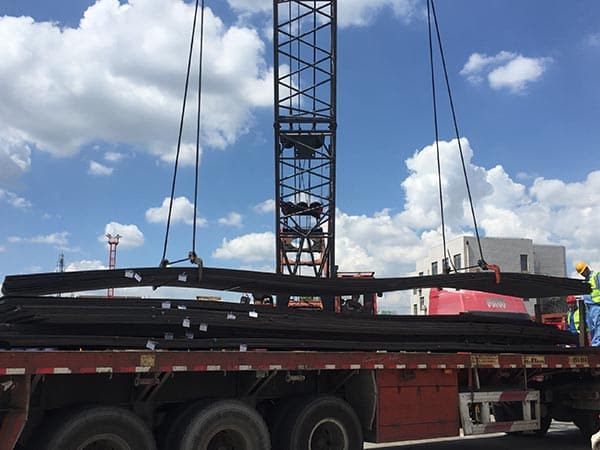
Protection begins the moment the 1.8969 steel leaves the mill. Improper storage, such as stacking plates directly on damp ground, can lead to uneven oxidation and 'water spotting,' which disrupts the uniform development of the patina. Using wooden dunnage and ensuring adequate airflow between plates prevents the onset of localized corrosion cells. Furthermore, during transport, avoiding contact with carbon steel chains or tools prevents 'iron contamination,' which can cause galvanic corrosion and localized cracking sites.
By integrating these technical insights—from the chemistry of the melt to the precision of the weld and the nuances of environmental exposure—the long-term quality and crack-free performance of 1.8969 high yield strength alloy steel can be guaranteed. This material is a robust solution for modern engineering, provided its specific 'temperament' is understood and respected through professional metallurgical practices.
Leave a message