
How to visually distinguish whether it is hot rolled or cold rolled s550mc high strength steel equivalent
Expert guide on visually distinguishing hot rolled S550MC from cold rolled high-strength steel equivalents, covering surface texture, scale, and performance.
Understanding the Nature of S550MC High Strength Steel
S550MC is a high-strength low-alloy (HSLA) steel grade governed by the EN 10149-2 standard. It is specifically designed for cold forming and is produced through a thermomechanical rolling process. When sourcing this material, engineers and purchasers often face the challenge of distinguishing between the standard hot-rolled (thermomechanically rolled) version and its cold-rolled equivalents, such as HC550LA. While both offer a minimum yield strength of 550 MPa, their surface characteristics, dimensional tolerances, and processing behaviors differ significantly due to their manufacturing routes.
The Visual Signature of Hot Rolled S550MC (As-Rolled)
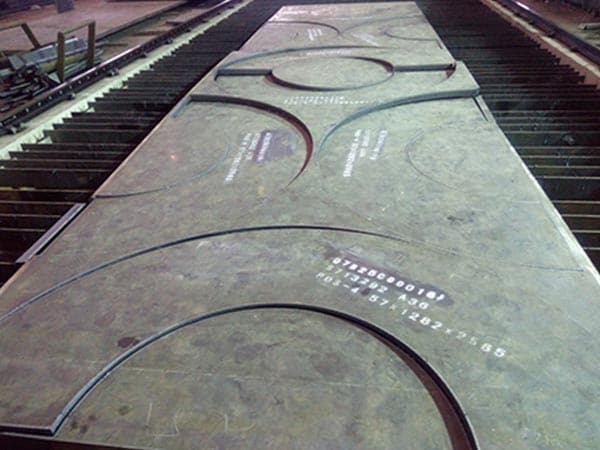
The most immediate way to identify hot-rolled S550MC is by examining the mill scale. During the thermomechanical rolling process, the steel is processed at high temperatures, leading to the formation of a dark, iron oxide layer on the surface. This scale typically appears as a matte, dark blue, or charcoal grey finish. Unlike lower-grade hot-rolled steels, S550MC has a more uniform and tightly adherent scale due to its refined micro-alloying elements like Niobium (Nb) and Titanium (Ti).
- Color: Dark grey to bluish-black.
- Texture: Slightly grainy or rough to the touch, similar to a very fine sandpaper.
- Reflectivity: Low; the surface is non-reflective and absorbs light.
Identifying Pickled and Oiled (P&O) Hot Rolled S550MC
Many manufacturers provide S550MC in a Pickled and Oiled (P&O) condition. This process removes the dark mill scale using an acid bath, leaving a clean, metallic surface. Distinguishing P&O S550MC from cold-rolled steel requires a closer look at the pore structure. P&O steel retains a slightly "open" surface texture. It appears as a uniform, dull silver-grey. Because it lacks the compression of cold rolling, you can often see very faint "pitting" or the natural grain of the steel under bright light.
Visual Characteristics of Cold Rolled S550MC Equivalents
Cold-rolled high-strength steels (like HC550LA) undergo an additional processing step where the hot-rolled coil is reduced in thickness at room temperature. This process drastically changes the visual and tactile profile of the metal. The surface becomes highly compressed, resulting in a much smoother and more lustrous appearance. If the material looks like a mirror or has a bright, silvery sheen, it is almost certainly a cold-rolled product rather than a standard S550MC.
- Surface Smoothness: Extremely smooth, often with a measured Ra (Roughness Average) value significantly lower than hot-rolled variants.
- Oil Film: Cold-rolled steel is almost always coated with a thin, transparent rust-preventative oil, which gives it a slick, wet look.
- Consistency: The color is exceptionally uniform across the entire width of the sheet, without the marbling often seen in hot-rolled coils.
Dimensional Precision and Edge Quality
Beyond the surface finish, the physical geometry of the steel provides critical clues. Hot-rolled S550MC typically has mill edges or slightly rounded slit edges. Because hot rolling is less precise, the thickness may vary slightly across the width of the sheet (crown). In contrast, cold-rolled equivalents boast superior dimensional accuracy. The edges are usually sharp and perfectly square if slit, and the thickness is remarkably consistent, often within microns of the target gauge.
| Feature | Hot Rolled S550MC (As-Rolled) | Hot Rolled S550MC (Pickled & Oiled) | Cold Rolled Equivalent (e.g., HC550LA) |
|---|---|---|---|
| Surface Color | Dark Grey / Blue-Black | Dull Silver / Matte Grey | Bright Silver / Metallic |
| Scale Presence | Heavy Oxide Scale | No Scale (Acid Cleaned) | No Scale (Cold Processed) |
| Tactile Feel | Rough / Grainy | Smooth but Matte | Silky / Oily / Slick |
| Thickness Range | Typically 1.5mm - 20mm | Typically 1.5mm - 12mm | Typically 0.5mm - 3.0mm |
| Edge Profile | Rounded / Mill Edge | Clean Slit Edge | Sharp / Precision Slit Edge |
The Role of Micro-Alloying in Visual Identification
S550MC achieves its high strength through micro-alloying rather than high carbon content. The presence of Vanadium, Niobium, and Titanium influences how the steel oxidizes. When you look at a cross-section of a sheared S550MC plate, the grain structure is so fine that the sheared edge appears much denser and smoother than that of a standard S235 or S355 steel. This "clean" shear is a hallmark of high-quality thermomechanically rolled HSLA steel.
Application-Based Visual Cues
The intended use of the steel often dictates which version you are looking at. If the steel is being used for heavy-duty structural components like crane booms, truck chassis, or trailer frames, it is almost certainly hot-rolled S550MC. These applications require the thickness and toughness that hot rolling provides. Conversely, if the steel is found in thin-walled, complex automotive brackets or lightweight electronic enclosures, it is likely a cold-rolled equivalent. Cold-rolled high-strength steel is preferred for components where aesthetic finish and tight tolerances are paramount.
Environmental Adaptation and Oxidation Patterns
Another visual test involves observing how the steel reacts to the environment. Hot-rolled S550MC with its mill scale is relatively resistant to atmospheric corrosion for short periods because the scale acts as a sacrificial barrier. However, once the scale is breached, it rusts in a patchy, uneven pattern. Cold-rolled steel, once the protective oil is wiped away, will develop a very uniform, fine "flash rust" across the entire surface due to its high surface energy and lack of protective oxide layer.
Mechanical Behavior as a Visual Proxy
While not strictly a visual check of the raw sheet, the bending behavior of the material reveals its origin. S550MC is optimized for cold flanging and bending. When bent, hot-rolled S550MC maintains a consistent texture around the radius. If the material were a lower-quality equivalent, you might see "orange peel" effects or micro-cracking on the outer tension zone. The superior grain refinement of genuine S550MC ensures that the surface remains visually intact even under severe deformation, a characteristic shared with high-end cold-rolled equivalents but executed on a thicker scale.
Summary of Professional Identification
To accurately distinguish these materials in a warehouse or production floor, one must combine visual inspection of the color and scale with tactile assessment of the texture and measurement of the gauge. Hot-rolled S550MC is the rugged workhorse, identified by its dark coat or matte pickled finish, while cold-rolled equivalents are the precision instruments of the steel world, marked by their brightness and exacting dimensions. Understanding these nuances ensures that the correct material is utilized for the specific engineering challenge at hand, maintaining both structural integrity and cost-efficiency.
Leave a message