
What is the en 10149-2 s315mc steel surface test
A detailed technical guide on EN 10149-2 S315MC steel surface testing, covering visual inspection, NDT methods, roughness benchmarks, and industrial quality requirements.
Technical Foundation of EN 10149-2 S315MC Surface Integrity
The EN 10149-2 S315MC designation represents a high-yield strength, thermomechanically rolled steel specifically designed for cold forming. Unlike traditional structural steels, S315MC relies on a precise micro-alloying process (using elements like Niobium, Vanadium, or Titanium) and controlled rolling temperatures to achieve its mechanical properties. Because this material is frequently subjected to extreme bending, stretching, and complex stamping, the surface test is not merely a cosmetic check; it is a critical verification of the material's structural viability and fatigue resistance.
The surface quality of S315MC is governed primarily by the EN 10163-2 standard, which categorizes surface requirements for hot-rolled plates, wide flats, and sections. For S315MC, which is often supplied in thin gauges (typically 1.5mm to 20mm), surface integrity directly dictates the success of subsequent processing steps such as laser cutting, robotic welding, and high-precision coating.
Core Components of the S315MC Surface Inspection
When engineers refer to the "surface test" for S315MC, they are usually describing a multi-faceted evaluation protocol. This protocol ensures that the thermomechanical rolling process has not introduced discontinuities that could lead to crack propagation during cold forming. The test encompasses visual inspection, dimensional verification, and, in specialized cases, non-destructive testing (NDT).
- Visual Examination: This is the primary method used to detect scale, pits, scratches, and slivers. The surface must be free from defects that would interfere with the intended use of the product.
- Surface Roughness Assessment: For applications involving painting or galvanizing, the Ra (Roughness Average) value is measured to ensure optimal coating adhesion.
- Scale and Oxide Evaluation: Since S315MC is thermomechanically rolled, the nature of the oxide layer (mill scale) is analyzed. In many cases, the material is supplied in a pickled and oiled condition to facilitate a cleaner surface test.
- Decarburization Depth: Although less common for low-carbon S315MC, certain high-stress applications require testing for carbon depletion at the surface layer, which can weaken the material's skin.
Surface Quality Classes and Acceptance Criteria
According to EN 10163-2, surface quality is divided into classes. Most S315MC orders default to Class A, Subclass 1, unless otherwise specified. This classification defines the allowable depth of imperfections relative to the nominal thickness of the plate.
| Feature | Requirement for S315MC | Testing Standard |
|---|---|---|
| Permissible Defects | Minor pores and shallow scratches within thickness tolerances. | EN 10163-2 |
| Repair Methods | Grinding is permitted if the remaining thickness is within limits. | EN 10149-2 Clause 7.4 |
| Surface Condition | Normally supplied as-rolled; pickled and oiled optional. | Customer Specification |
| Weldability Impact | Surface must be free of heavy grease or thick scale. | ISO 17637 |
The Role of Non-Destructive Testing (NDT) in Surface Evaluation
While visual inspection covers macro-defects, high-end automotive and heavy machinery components require more rigorous S315MC surface tests. These include:
Magnetic Particle Inspection (MPI): This is utilized to detect fine surface and near-surface cracks that are invisible to the naked eye. In S315MC, such cracks can occur if the cooling rate during the thermomechanical rolling was inconsistent.
Ultrasonic Testing (UT): While typically used for internal laminations, high-frequency UT can identify surface-breaking defects in thicker sections of S315MC. This ensures that the "skin" of the steel is perfectly bonded to the core, preventing delamination during tight-radius bending.
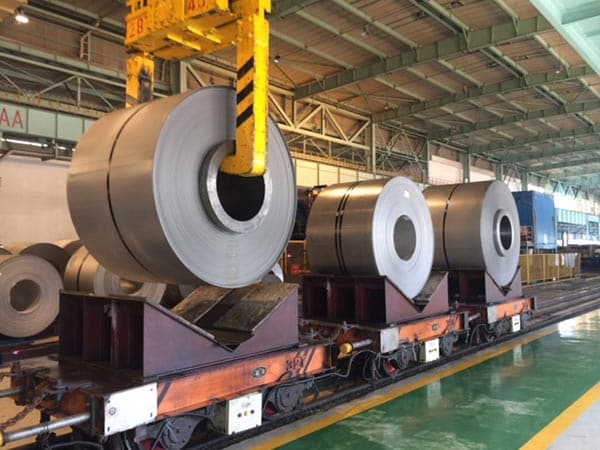
Eddy Current Testing: Often used in automated production lines for S315MC coils, this test identifies longitudinal defects and surface irregularities at high speeds, ensuring that every meter of the coil meets the S315MC standard.
Dimensional Tolerances and Surface Flatness
A critical part of the surface test for EN 10149-2 S315MC involves measuring flatness and thickness uniformity. Because S315MC is frequently used in automated laser cutting and robotic assembly, even minor surface waves can disrupt the focal point of a laser or the alignment of a weld seam.
The standard EN 10051 governs the tolerances for hot-rolled sheets and strips. For S315MC, the surface must be flat enough to prevent "spring-back" issues during cold forming. A surface test in this context involves using a straightedge or a laser scanner to measure deviations over a specific length (e.g., 1000mm or 2000mm).
Environmental Adaptability and Surface Protection
S315MC is often used in environments where it is exposed to moisture and mechanical stress. The surface test must therefore account for the material's reaction to its surroundings. If the steel is supplied as "pickled and oiled," the oil film must be uniform. This film serves two purposes: it prevents flash rusting during transit and acts as a preliminary lubricant for the first stage of cold pressing.
For industries like truck chassis manufacturing, the surface must be conducive to KTL (Cathodic Dip Painting). If the surface test reveals excessive silicon or phosphorus at the surface (segregation), it can lead to uneven coating thickness, which eventually causes premature corrosion. Therefore, the chemical analysis of the surface layer is often performed alongside physical tests.
Impact of Surface Quality on Cold Forming Performance
The "MC" in S315MC stands for Thermomechanically Rolled (M) and Cold Forming (C). The surface test is the ultimate predictor of how the steel will behave in a press brake. If the surface contains micro-notches or "slivers" (thin layers of metal rolled into the surface), these act as stress concentrators. Under the tension of a 90-degree bend, these notches can open into visible cracks, leading to part rejection.
Minimum Bending Radius: For S315MC with a thickness (t), the recommended internal bending radius is typically 0.25t to 0.5t. However, this is only achievable if the surface test confirms a smooth, defect-free exterior. A rough or pitted surface effectively increases the required bending radius, limiting the design flexibility of the component.
S315MC Surface Requirements in Global Supply Chains
In the global market, S315MC is frequently compared to ASTM or JIS equivalents. However, the EN 10149-2 surface test is known for its stringency regarding rolling defects. Suppliers must provide a Mill Test Certificate (MTC) according to EN 10204 3.1, which explicitly states that the surface inspection was performed and met the requirements of the order.
For procurement specialists, it is vital to specify the surface finish. While the standard allows for an "as-rolled" finish, many high-precision industries demand a shot-blasted and primed or pickled surface to ensure that the surface test can be performed with maximum accuracy. A clean surface allows for the detection of subtle "rolling-in" of scale, which is a common issue in thermomechanically processed steels if the descaling sprays during rolling were not perfectly synchronized.
Advanced Surface Characterization for High-End Applications
As manufacturing moves toward Industry 4.0, the S315MC surface test is evolving. Automated Optical Inspection (AOI) systems are now being used to scan 100% of the surface area of S315MC coils. These systems use high-resolution cameras and AI algorithms to classify defects in real-time, providing a digital map of the surface quality. This level of detail is becoming a standard requirement for Tier 1 automotive suppliers who cannot afford a single defect in a high-volume production run.
By understanding the nuances of the EN 10149-2 S315MC surface test, from visual standards to NDT and dimensional tolerances, manufacturers can ensure they are using a material that not only meets the yield strength requirements but also possesses the surface integrity necessary for complex, high-performance engineering tasks.
Leave a message