
What is the process principle of S700MC yield strength
Discover the technical principles behind S700MC's 700MPa yield strength. This guide covers TMCP rolling, micro-alloying with Nb, Ti, and V, and industrial applications for high-performance structural steel.
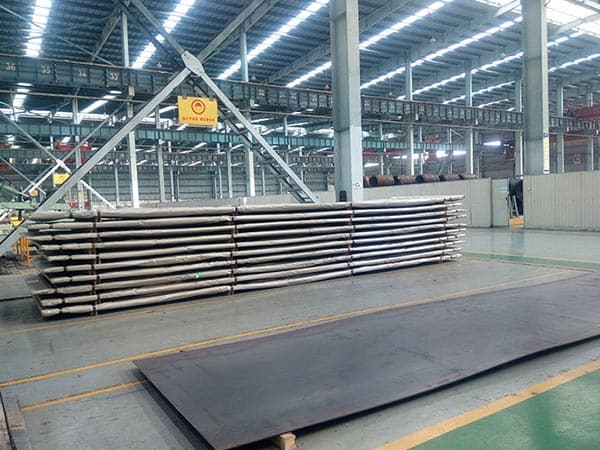
Understanding the Foundation of S700MC Yield Strength
S700MC is a high-strength, hot-rolled structural steel designed for cold forming, governed by the European standard EN 10149-2. The designation 'S' stands for structural steel, '700' refers to the minimum yield strength of 700 MPa, and 'MC' indicates a thermomechanically rolled (M) condition with high cold-forming (C) properties. Achieving such high yield strength while maintaining excellent ductility and weldability requires a sophisticated interplay of metallurgical principles and advanced manufacturing technology.
Unlike traditional normalized steels that rely on heat treatment to achieve specific properties, S700MC derives its strength from a combination of grain refinement, precipitation hardening, and dislocation strengthening. These mechanisms are orchestrated through a precise Thermomechanical Control Process (TMCP), which manipulates the microstructure during the rolling phase rather than through post-rolling thermal cycles.
The Role of TMCP: Thermomechanical Control Process
The primary process principle behind S700MC's yield strength is the Thermomechanical Control Process (TMCP). This process involves controlled rolling at specific temperature ranges followed by accelerated cooling. TMCP differs from conventional rolling by focusing on the deformation of austenite in the non-recrystallization temperature range.
- Stage 1: Reheating: The steel slab is heated to a temperature where micro-alloying elements like Niobium (Nb) and Titanium (Ti) are fully dissolved into the austenite matrix.
- Stage 2: Roughing Rolling: Initial deformation occurs at high temperatures where recrystallization is rapid, resulting in a refined austenitic grain size.
- Stage 3: Finishing Rolling: This is the critical phase for S700MC. Rolling occurs below the recrystallization stop temperature (Tnr). Instead of forming new grains, the austenite grains are flattened (pancaked), creating a high density of deformation bands and dislocations.
- Stage 4: Accelerated Cooling: Rapid cooling transforms the heavily deformed austenite into an extremely fine-grained ferrite and bainite structure.
Micro-alloying Synergy: Nb, V, and Ti
S700MC utilizes a low-carbon chemistry enriched with micro-alloying elements, typically Niobium (Nb), Vanadium (V), and Titanium (Ti). These elements are the 'engine' of the yield strength principle through two main mechanisms: Grain Refinement and Precipitation Hardening.
Grain refinement follows the Hall-Petch relationship, which states that as grain size decreases, yield strength increases. Micro-alloying elements inhibit grain growth during reheating and rolling. Specifically, TiN (Titanium Nitride) particles are stable at very high temperatures, pinning grain boundaries and preventing austenite grain coarsening. During the finishing rolling, Nb in solution retards recrystallization, ensuring the 'pancaking' effect mentioned earlier.
Precipitation hardening occurs as the steel cools. Fine carbides and nitrides of Nb, V, and Ti precipitate within the ferrite matrix. These nano-sized particles act as obstacles to dislocation movement (the Orowan mechanism), significantly boosting the yield strength without drastically reducing toughness. This dual-action allows S700MC to reach 700 MPa with a carbon content often below 0.12%, which is essential for its superior weldability.
Comparative Mechanical Performance
To understand the leap in performance S700MC provides, it is useful to compare it with standard structural grades like S355. The following table highlights the significant strength-to-weight ratio advantage of S700MC.
| Property | s355jr (Normalized) | S700MC (TMCP) |
|---|---|---|
| Yield Strength (MPa) | ≥ 355 | ≥ 700 |
| Tensile Strength (MPa) | 470 - 630 | 750 - 950 |
| Elongation (%) | ≥ 20 | ≥ 12 (t < 3mm) / ≥ 14 (t ≥ 3mm) |
| Carbon Equivalent (CEV) | ~ 0.45 | ~ 0.38 |
Advanced Cold Forming and Processing Characteristics
Despite its high strength, S700MC is engineered for complex fabrication. The 'C' in its name signifies its suitability for cold forming. Because the high strength is achieved via grain refinement rather than high carbon or alloy content, the steel remains ductile. Engineers can utilize tighter bending radii compared to other steels of similar strength.
When calculating the minimum bending radius, S700MC typically allows for a radius of 1.0 to 1.5 times the plate thickness (t) for 90-degree bends, depending on the rolling direction. This makes it ideal for manufacturing U-beams, C-channels, and complex chassis components. However, fabricators must account for 'springback'—the tendency of the metal to return to its original shape after bending. S700MC exhibits higher springback than S355 due to its higher elastic limit, requiring precise over-bending in the tool design.
Welding Integrity and Heat Affected Zone (HAZ)
The welding principle for S700MC centers on its low Carbon Equivalent (CEV). A lower CEV reduces the risk of cold cracking and eliminates the need for preheating in most thickness ranges. Common methods include MAG (Metal Active Gas), MIG, and Laser welding.
However, because S700MC's strength is derived from TMCP and precipitation, excessive heat input can lead to 'softening' in the Heat Affected Zone (HAZ). If the cooling rate is too slow (high heat input), the fine precipitates may coarsen, and the refined grain structure may grow, locally reducing the yield strength. To maintain the 700 MPa integrity, it is recommended to use low heat input techniques and control the interpass temperature. Matching or slightly over-matching filler metals are typically used to ensure the weld joint's strength meets the parent metal's specifications.
Environmental Adaptability and Fatigue Resistance
In heavy-duty applications, S700MC is often subjected to cyclic loading and harsh environments. The fine-grained microstructure provides an inherent advantage in fatigue resistance. Smaller grains limit the path of crack propagation, extending the fatigue life of structural components like crane booms and truck frames.
Regarding low-temperature toughness, S700MC is often available in grades like S700MCK2, which guarantees impact energy values at -40C. This environmental adaptability is crucial for machinery operating in arctic conditions or high-altitude environments. The clean steelmaking process, involving vacuum degassing and calcium treatment for inclusion shape control, ensures that the steel remains tough even when stressed at sub-zero temperatures.
Industrial Implementation and Economic Efficiency
The shift toward S700MC is driven by the global demand for lightweighting. By doubling the yield strength compared to S355, designers can reduce the thickness of structural members by 30% to 40% while maintaining the same load-bearing capacity. This leads to a cascade of economic benefits:
- Weight Reduction: Lower vehicle curb weight increases payload capacity and reduces fuel consumption.
- Material Savings: Less steel is required per unit, offsetting the higher cost per ton of S700MC.
- Processing Efficiency: Thinner sections mean faster welding times and reduced filler metal consumption.
- Sustainability: Reduced material usage and lower transport emissions contribute to a smaller carbon footprint.
Heavy lifting, automotive transportation, and mobile crane manufacturing are the primary sectors leveraging these principles. In the production of telescopic crane booms, S700MC provides the necessary stiffness and strength to reach greater heights without adding prohibitive weight.
Strategic Considerations for Engineering Design
Implementing S700MC requires a shift in engineering mindset. Designers must prioritize stiffness and buckling resistance, as the Young's Modulus of S700MC is the same as S355 despite the higher yield strength. This means that while the part won't permanently deform (yield), it will deflect similarly under the same load if the thickness is reduced too aggressively. Strategic use of stiffeners and optimized geometries (like corrugated webs) allows engineers to fully exploit the 700 MPa yield strength without compromising structural stability.
By mastering the process principles of S700MC—from the microscopic grain refinement to the macroscopic TMCP rolling parameters—manufacturers can produce equipment that is stronger, lighter, and more durable, meeting the rigorous demands of modern infrastructure and logistics.
Leave a message