
Does S315MC steel for cold forming parts rust easily?
A technical analysis of S315MC steel's corrosion resistance, chemical composition, and environmental performance for cold-formed automotive and structural parts.
The Metallurgical Identity of S315MC Steel
S315MC is a high-yield strength steel specifically designed for cold forming, governed by the EN 10149-2 standard. This grade is thermomechanically rolled, a process that ensures a fine-grained microstructure, providing an optimal balance between strength and ductility. When addressing the question of whether S315MC rusts easily, it is essential to recognize that it belongs to the category of non-alloy or low-alloy steels. Unlike stainless steel, which contains a high percentage of chromium to form a passive protective layer, S315MC is primarily composed of iron, making it inherently susceptible to oxidation when exposed to moisture and oxygen.
The "MC" designation indicates that this steel is thermomechanically rolled (M) and intended for cold forming (C). This manufacturing route influences the surface texture and the internal stress state of the material, both of which play secondary roles in its electrochemical behavior. While the steel itself does not possess inherent "rust-proof" properties, its corrosion rate is highly dependent on the surface finish provided at the time of delivery and the subsequent processing steps taken by the manufacturer.
Chemical Composition and Oxidation Mechanisms
The chemical blueprint of S315MC is engineered for weldability and formability rather than extreme corrosion resistance. However, the specific levels of certain elements do influence how the initial stages of oxidation progress. By keeping carbon levels low, the steel maintains better uniform corrosion characteristics compared to high-carbon steels, which may experience more localized galvanic cells between ferrite and cementite phases.
| Element | Maximum Percentage (%) | Influence on Performance |
|---|---|---|
| Carbon (C) | 0.12 | Ensures ductility and reduces the risk of brittle fracture. |
| Manganese (Mn) | 1.30 | Improves strength and helps in deoxidation. |
| Silicon (Si) | 0.50 | Acts as a deoxidizer; high levels can affect galvanizing quality. |
| Phosphorus (P) | 0.025 | Kept low to prevent cold shortness and improve toughness. |
| Sulphur (S) | 0.020 | Minimized to prevent sulfide inclusions that act as corrosion pits. |
| Niobium (Nb) / Titanium (Ti) | 0.09 / 0.15 | Micro-alloying elements for grain refinement and strength. |
From a technical standpoint, the absence of significant amounts of Chromium (Cr), Nickel (Ni), or Copper (Cu) means that S315MC cannot form a stable, adherent oxide layer (patina) like weathering steel or stainless steel. When exposed to a humid environment, the iron atoms on the surface lose electrons to oxygen, forming iron hydroxides, commonly known as red rust. The micro-alloying elements like Niobium and Titanium are present in such small quantities that they do not significantly alter the electrochemical potential of the bulk material.
Surface State: Hot Rolled vs. Pickled and Oiled
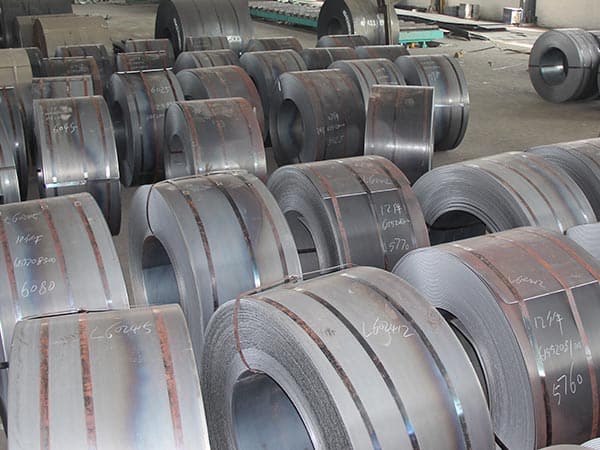
The answer to "does it rust easily" depends heavily on the surface condition. S315MC is typically available in two primary surface states: as-rolled (black) and pickled and oiled (P&O). These states offer vastly different levels of immediate protection against atmospheric corrosion.
- As-Rolled (Black) Surface: This surface is covered with a layer of mill scale (magnetite and wüstite) formed during the hot-rolling process. While mill scale provides a physical barrier, it is brittle and often contains microscopic cracks. If moisture penetrates these cracks, a galvanic cell is formed between the scale and the underlying steel, which can actually accelerate localized pitting corrosion.
- Pickled and Oiled (P&O): The mill scale is chemically removed using an acid bath, leaving a clean, silver-grey metallic surface. Because this bare steel is highly reactive, a thin layer of protective oil is applied. In this state, S315MC will not rust as long as the oil film remains intact. However, if the oil is washed off or evaporates during storage, the steel will "flash rust" almost immediately in humid conditions.
Impact of Cold Forming on Corrosion Susceptibility
S315MC is prized for its ability to be bent, pressed, and drawn into complex shapes. However, the cold forming process itself introduces physical changes that can indirectly affect rust formation. When the steel is deformed, the dislocation density within the crystal lattice increases, leading to higher internal energy. Areas with high residual stress, such as tight bends or stamped edges, can become more anodic than the surrounding undeformed material.
Furthermore, cold forming often causes microscopic stretching or thinning of any protective oil film or pre-applied coating. If the forming tools are not properly maintained, they can embed small particles of foreign metal or debris into the surface of the S315MC part. These inclusions act as focal points for moisture accumulation and subsequent corrosion. For high-precision automotive components, it is standard practice to degrease and apply a more permanent surface treatment immediately after the cold forming stage to mitigate these risks.
Environmental Adaptability and Industry Applications
In dry, indoor environments, S315MC can remain rust-free for extended periods even without heavy protection. However, its performance shifts dramatically when moving into industrial or coastal atmospheres. The presence of chlorides (from sea salt) or sulfur dioxides (from industrial pollution) acts as a catalyst, breaking down the initial oxide layers and facilitating rapid metal loss.
Within the automotive industry, S315MC is frequently used for chassis parts, brackets, and structural reinforcements. These components are rarely used in their "raw" state. Instead, they undergo sophisticated multi-stage coating processes. The sequence typically involves alkaline cleaning, zinc phosphating, and then Electrolytic Cathodic Coating (KTL/E-coat). This provides a robust barrier that allows S315MC to survive thousands of hours in salt spray testing, effectively neutralizing its natural tendency to rust.
In the heavy machinery and logistics sectors, such as the production of racking systems or crane arms, S315MC parts may be powder coated or hot-dip galvanized. Hot-dip galvanizing is particularly effective for S315MC, though the silicon and phosphorus content must be monitored to ensure a controlled growth of the zinc-iron alloy layer (avoiding the Sandelin effect). Once galvanized, the rust concern is virtually eliminated for decades.
Best Practices for Handling and Storage
To prevent premature rusting of S315MC before it reaches the final assembly line, several operational protocols are recommended. Storage conditions are the most critical factor. Steel coils or sheets should be kept in temperature-controlled warehouses with low relative humidity (below 60%). Rapid temperature fluctuations must be avoided to prevent "sweating" or condensation on the metal surface, which is a primary cause of white rust (on galvanized surfaces) or red rust (on bare steel).
During transport, S315MC should be protected from direct exposure to rain and road salts. If the material is pickled and oiled, it is vital to check the integrity of the packaging. If the steel becomes wet during transit, it must be dried immediately and re-oiled, as the water can become trapped between the layers of the coil, leading to uniform surface oxidation that is difficult to remove without re-pickling.
Comparative Analysis with Other Grades
When compared to standard structural steels like S235JR, S315MC offers higher strength, allowing for thinner sections and weight reduction (lightweighting). From a corrosion perspective, they are very similar, as both are carbon-manganese steels. However, the cleaner chemistry and finer grain structure of S315MC often result in a more uniform surface finish after pickling, which can lead to better adhesion for paints and coatings, indirectly improving the long-term corrosion resistance of the finished product.
In contrast, compared to cold-rolled grades like DC01, S315MC has a different surface morphology due to the hot-rolling process. While DC01 has a smoother finish, S315MC provides the structural integrity needed for load-bearing cold-formed parts. The choice between these materials usually hinges on mechanical requirements rather than a difference in rust susceptibility, as both require identical levels of post-processing protection.
Strategic Considerations for Engineers
When specifying S315MC for a project, the focus should not be on its lack of rust resistance, but on the strategy used to protect it. It is a highly reliable material that performs exceptionally well under mechanical stress. By understanding that it will rust if left bare, engineers can design systems that incorporate proper drainage (to avoid water pooling), ventilation, and appropriate coating specifications. When these factors are managed, S315MC serves as an excellent, cost-effective solution for high-strength components across a wide array of demanding environments.
Leave a message