
How to visually distinguish whether it is hot rolled or cold rolled en 10149-2 high yield strength alloy steel specifica
Comprehensive guide on visually and technically distinguishing EN 10149-2 high yield strength alloy steel, covering surface finish, tolerances, and mechanical properties.
Understanding the Core Nature of EN 10149-2 Specifications
EN 10149-2 is a European standard specifically designed for hot rolled high yield strength steels intended for cold forming. While the standard itself defines hot-rolled products, confusion often arises in the supply chain when these materials are compared to cold-rolled counterparts or when they are supplied in a pickled and oiled (P&O) state. Identifying these materials correctly is vital for structural integrity, especially in weight-sensitive applications like crane manufacturing and automotive chassis production.
The "MC" suffix in grades like S355MC or S700MC stands for "Thermomechanically Rolled." This process is a hybrid of thermal control and mechanical deformation, which results in a fine-grained microstructure. This fine grain is what allows the steel to maintain high yield strength while remaining exceptionally ductile for bending and folding. Distinguishing these from traditional cold-rolled sheets requires a keen eye for surface texture, edge profile, and thickness consistency.
Surface Texture and Mill Scale Observations
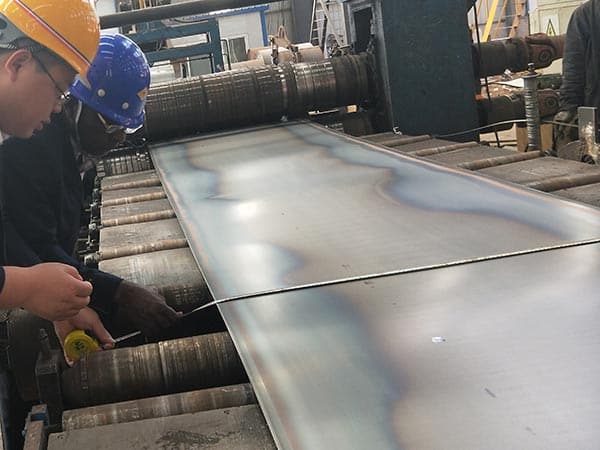
The most immediate visual indicator of EN 10149-2 steel is its surface finish. Because it is a hot-rolled product, it typically leaves the mill with a mill scale—a thin, dark blue or black layer of iron oxide. This scale is the result of the steel reacting with oxygen at high temperatures during the rolling process.
- As-Rolled Condition: The surface will appear matte, slightly rough, and dark. If you run your hand over it, you may feel a slight graininess. This is vastly different from cold-rolled steel, which has a bright, smooth, and oily appearance.
- Pickled and Oiled (P&O): Many EN 10149-2 steels are processed through an acid bath to remove the mill scale. After pickling, the steel takes on a uniform, matte grey appearance. While this looks cleaner, it still lacks the reflective, mirror-like sheen of true cold-rolled steel.
- Surface Imperfections: Hot-rolled high-yield steel may show subtle "pitting" or slight impressions from the rollers, which are generally absent in the high-precision finishing of cold-rolled products.
Dimensional Tolerances and Edge Characteristics
Another way to visually and physically distinguish EN 10149-2 is by examining the edges and measuring the thickness. Hot-rolled products follow EN 10051 tolerances, which are generally wider than the EN 10131 tolerances used for cold-rolled products.
| Feature | EN 10149-2 (Hot Rolled) | Cold Rolled Equivalents |
|---|---|---|
| Thickness Range | Typically 1.5mm to 20mm | Typically 0.3mm to 3.0mm |
| Edge Quality | Often "Mill Edge" (rounded/irregular) or slit | Almost always precision slit or smooth square |
| Thickness Uniformity | Slight crown (thicker in the center) | Highly uniform across the width |
| Surface Roughness (Ra) | Higher (Matte/Rough) | Lower (Smooth/Bright) |
If the material exceeds 3.0mm in thickness, it is almost certainly hot-rolled EN 10149-2, as cold rolling high-yield alloy steel to those thicknesses requires immense pressure and is rarely commercially viable. Furthermore, if you observe a rounded mill edge, it is a definitive sign of the hot rolling process.
Mechanical Performance and the Bending Test
The "High Yield Strength" aspect of EN 10149-2 (ranging from 315 MPa to 700 MPa) significantly influences how the material behaves under stress. While you cannot "see" yield strength, you can observe the material's reaction to cold forming. These steels are engineered for tight bending radii without cracking.
When bending a piece of S700MC, the outer radius remains smooth due to the thermomechanical processing. In contrast, a standard high-carbon steel of similar strength that was not thermomechanically rolled would likely exhibit "orange peel" texture or micro-cracking on the bend line. The ability to achieve a 1.0t or 1.5t bending radius (where t is thickness) is a hallmark of the EN 10149-2 specification.
Chemical Composition and Micro-Alloying
The visual distinction is often supported by the chemical signature of the steel. EN 10149-2 grades utilize micro-alloying elements like Niobium (Nb), Titanium (Ti), and Vanadium (V). These elements are added in minute quantities (usually less than 0.2% combined) to refine the grain size during the hot rolling process.
- Carbon Content: Kept very low (often <0.12%) to ensure excellent weldability.
- Sulfur and Phosphorus: These are strictly limited to improve internal cleanliness, which prevents delamination during heavy bending.
- Manganese: Used to provide solid solution strengthening without sacrificing toughness.
This chemical balance ensures that the steel does not harden excessively during welding, a common problem with older high-strength steel formulations. If a sample shows excellent weld bead wetting and a narrow heat-affected zone (HAZ), it likely meets the EN 10149-2 criteria.
Industry-Specific Applications and Environmental Adaptability
Identifying the steel often comes down to where it is being used. EN 10149-2 is the backbone of the heavy transport and lifting industry. Because of its high strength-to-weight ratio, it is the preferred choice for telescopic crane booms, truck chassis, and agricultural equipment.
In terms of environmental adaptability, the thermomechanical rolling process provides a fine-grained structure that offers better resistance to brittle fracture at low temperatures compared to standard s355jr structural steels. This makes it suitable for equipment operating in cold climates. However, because it is an alloy steel and not a stainless or galvanized product, it requires protective coatings (painting or powder coating) if exposed to corrosive environments. The pickled surface of EN 10149-2 provides an ideal substrate for paint adhesion, far superior to the scaly surface of standard hot-rolled plate.
Practical Verification Steps for Procurement
When visually inspecting a shipment to confirm it is EN 10149-2 rather than a generic cold-rolled or structural steel, follow these steps:
1. Check the Marking: Genuine EN 10149-2 will be hard-stamped or inkjet-printed with the grade (e.g., S500MC) and the heat number. Look for the "MC" designation specifically. Do not accept material marked only with yield strength, as it may lack the thermomechanical properties required for forming.
2. Inspect the Surface: Look for the characteristic matte grey (if pickled) or blue-black (if as-rolled) finish. Use a micrometer to check for thickness consistency; a slight variation within EN 10051 limits is normal for hot-rolled products.
3. Review the MTC (Mill Test Certificate): Ensure the certificate mentions EN 10149-2 and lists the micro-alloying elements (Nb, Ti, V). The rolling condition should be stated as "+M" (Thermomechanically Rolled).
By combining visual inspection of the surface and edges with a technical understanding of the thermomechanical process, professionals can accurately identify and utilize EN 10149-2 steel to its full potential, ensuring both safety and efficiency in high-stress engineering projects.
Leave a message